
Technical Support & Resources
Visit our FAQ
Contact Us
Toll Free Phone (USA and Canada Only): (888) 526-5351
Direct Phone: (734) 975-3888
Product Categories
Product Type
Prostatic Acid Phosphatase (mouse, recombinant)
Item No. 38071
Technical Information
- Acid Phosphatase 3
- PAcP
- PAP
- PPAP
- Protein Tyrosine Phosphatase ACP3
- Secretory Prostatic Acid Phosphatase
Shipping & Storage Information
Recommended Products
Certificates of Analysis & Batch Specific Data
Provide batch numbers separated by commas to download or request available product inserts, QC sheets, certificates of analysis, data packs, and GC-MS data.

Visit Our Cancer Resource Center
Find Tools & Resources to Study the Hallmarks of Cancer
- Cancer cell signaling & regulation
- Cancer metabolism
- Tumor microenvironment
Product Description
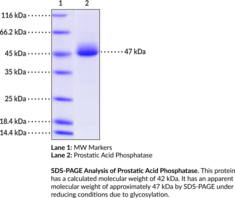
Prostatic acid phosphatase is a member of the protein tyrosine phosphatase (PTP) family.1 It exists as a homodimer and each monomer is composed of a signal peptide, which, once cleaved, produces a catalytically active enzyme, and two domains where the larger domain contains an α/β-hydrolase fold and the smaller domain contains mostly α-helices. Alternative splicing of the gene encoding prostatic acid phosphatase, Acp3, generates a secreted form that is expressed in prostate tissues and semen, and a transmembrane form that is expressed in several tissues.2,3,4 In addition to its phosphatase activity, prostatic acid phosphatase also has ectonucleotidase activity against AMP, ADP, and ATP in a pH-dependent manner.5 Intrathecal administration of recombinant mouse prostatic acid phosphatase has antinociceptive activity in a mouse model of inflammatory pain induced by complete Freund’s adjuvant (CFA). Serum levels of prostatic acid phosphatase are increased in patients with prostate cancer and vaginal prostatic acid phosphatase activity has been used as a marker of sexual abuse.1,6 Cayman’s Prostatic Acid Phosphatase (mouse, recombinant) protein consists of 361 amino acids, has a calculated molecular weight of 42 kDa, and a predicted N-terminus of Lys32 after signal peptide cleavage. By SDS-PAGE, under reducing conditions, the apparent molecular mass of the protein is 47 kDa due to glycosylation.
WARNING This product is not for human or veterinary use.
References & Product Citations
1. Human prostatic acid phosphatase: Structure, function and regulation. Int. J. Mol. Sci. 14(5), 10438-10464 (2013).
2. Molecular cloning and sequence analysis of cDNA encoding human prostatic acid phosphatase. FEBS Lett. 236(2), 275-281 (1988).
3. Acid phosphatase and zinc in semen of subjects with no clinical evidence of prostatic disease. Clin. Chem. 31(6), 878-880 (1985).
4. Prostatic acid phosphatase is not a prostate specific target. Cancer Res. 67(14), 6549-6554 (2007).
5. Recombinant mouse PAP has pH-
6. Comparison between prostate specific antigen and acid phosphatase for detection of semen in vaginal swabs from raped women. J. Forensic Leg. Med. 20(6), 578-581 (2013).
Contact Info
Cayman Chemical1180 East Ellsworth RoadAnn Arbor, Michigan 48108 USAToll Free: (800) 364-9897(USA and Canada only)Fax: (734) 971-3640


