
Technical Support & Resources
Visit our FAQ
Contact Us
Toll Free Phone (USA and Canada Only): (888) 526-5351
Direct Phone: (734) 975-3888
Technical Information
- S100β
- S100 Calcium-binding Protein B
- S100 Protein β Chain
- S100 Protein Subunit β
Shipping & Storage Information
Recommended Products
Certificates of Analysis & Batch Specific Data
Provide batch numbers separated by commas to download or request available product inserts, QC sheets, certificates of analysis, data packs, and GC-MS data.
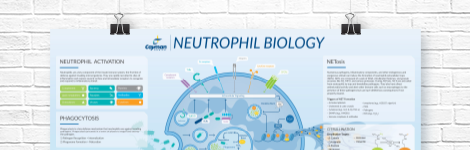
Neutrophil Biology Wall Poster
Explore how neutrophils shape the immune response in health and disease. This poster highlights neutrophil pathogen defense mechanisms, including phagocytosis, degranulation, and NETosis, as well as neutrophil roles in inflammation and NET-associated pathologies.
DOWNLOAD NOWProduct Description
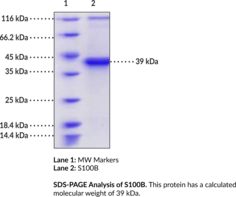
S100 calcium-binding protein B (S100B) is a homodimeric protein, with each subunit containing two EF-hand calcium-binding domains.1 S100B is expressed primarily in astrocytes but also by neural progenitor cells, dendritic cells, some lymphocyte subpopulations, and maturing oligodendrocytes. S100B has intracellular roles in calcium homeostasis, cell proliferation, energy metabolism, cytoskeletal regulation, and motility. It is also released extracellularly in response to various forms of brain injury and acts as a damage-associated molecular pattern (DAMP) through its interaction with receptor for advanced glycation end products (RAGE).1,2,3,4 Peripheral blood levels of S100B are increased in patients with autism spectrum disorder, acute ischemic stroke, or neonatal brain injury.2,3,4 Cayman’s S100B (mouse, recombinant) protein is a disulfide-linked homodimer. The reduced monomer, composed of S100B (amino acids 2-92) fused to human IgG1 Fc at its N-terminus, consists of 351 amino acids, and has a calculated molecular weight of 39 kDa.
WARNING This product is not for human or veterinary use.
References & Product Citations
1. .
2. .
3. .
4. .
Contact Info
Cayman Chemical1180 East Ellsworth RoadAnn Arbor, Michigan 48108 USAToll Free: (800) 364-9897(USA and Canada only)Fax: (734) 971-3640


