
Technical Support & Resources
Visit our FAQ
Contact Us
Toll Free Phone (USA and Canada Only): (888) 526-5351
Direct Phone: (734) 975-3888
Product Categories
Technical Information
- CD107a
- CD107 Antigen-like Family Member A
- Lysosome-associated Membrane Glycoprotein 1
- Lysosome-associated Membrane Protein 1
Shipping & Storage Information
Recommended Products
Certificates of Analysis & Batch Specific Data
Provide batch numbers separated by commas to download or request available product inserts, QC sheets, certificates of analysis, data packs, and GC-MS data.

Visit Our Cancer Resource Center
Find Tools & Resources to Study the Hallmarks of Cancer
- Cancer cell signaling & regulation
- Cancer metabolism
- Tumor microenvironment
Product Description
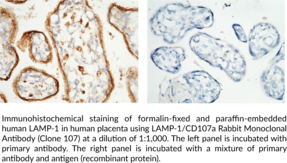
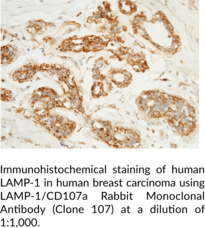
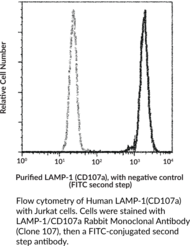
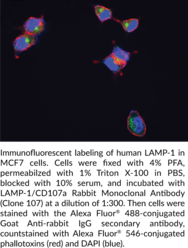
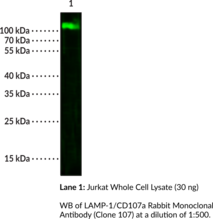
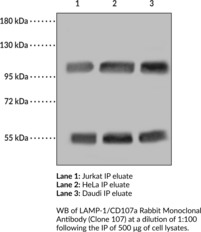
Lysosome-associated membrane protein 1 (LAMP-1), also known as CD107a, is an abundant lysosomal integral membrane glycoprotein.1 It is composed of a signal peptide, two LAMP-like domains that are separated by a proline-rich hinge region, a transmembrane domain, and a C-terminal tail that contains a YXXI tyrosine-based motif, which is required for targeting of LAMP-1 to the lysosome.1,2 LAMP-1 is ubiquitously expressed and localizes to lysosomes, endosomes, and the plasma membrane.1,2 It is involved in human peripheral blood mononuclear cells (PBMC) adhesion to vascular endothelium, natural killer (NK) cell degranulation, virus entry, and cancer progression and metastasis.3,4,5,6 Homozygous knockout of Lamp1 prevents Lassa virus infection in mice.5 Pulmonary protein levels of LAMP-1 are increased in patients with chronic obstructive pulmonary disease (COPD), and increased LAMP-1 lung levels positively correlate with smoking history and negatively correlate with lung function.7 Cayman’s LAMP-1/CD107a Rabbit Monoclonal Antibody (Clone 107) can be used for ELISA, flow cytometry (FC), immunocytochemistry (ICC), immunofluorescence (IF), immunohistochemistry paraffin (IHC-P), immunoprecipitation (IP), and Western blot (WB) applications. The antibody recognizes LAMP-1 at 120 kDa from human samples.
WARNING This product is not for human or veterinary use.
References & Product Citations
1. Structure of human lysosomal membrane glycoprotein 1. Assignment of disulfide bonds and visualization of its domain arrangement. The Journal of Biological Chemisty 264(34), 20526-20531 (1989).
2. The targeting of lamp1 to lysosomes is dependent on the spacing of its cytoplasmic tail tyrosine sorting motif relative to the membrane. J. Cell Biol. 132(4), 565-576 (1996).
3. Lysosome-
4. LAMP1/CD107a is required for efficient perforin delivery to lytic granules and NK-
5. Lassa virus entry requires a trigger-
6. LAMPs: Shedding light on cancer biology. Semin. Oncol. 44(4), 239-253 (2017).
7. Dysregulation of endocytic machinery and ACE2 in small airways of smokers and COPD patients can augment their susceptibility to SARS-
Contact Info
Cayman Chemical1180 East Ellsworth RoadAnn Arbor, Michigan 48108 USAToll Free: (800) 364-9897(USA and Canada only)Fax: (734) 971-3640


