
Technical Support & Resources
Visit our FAQ
Contact Us
Toll Free Phone (USA and Canada Only): (888) 526-5351
Direct Phone: (734) 975-3888
Product Categories
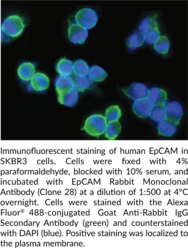
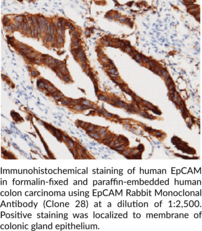
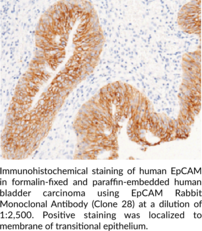
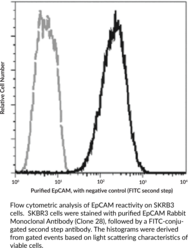
Technical Information
- Adenocarcinoma-associated Antigen
- CD326
- EGP314
- Epithelial Cell Adhesion Molecule
- Epithelial Cell Surface Antigen
- Epithelial Glycoprotein 314
- TACSTD1
- TROP1
- Tumor-associated Calcium Signal Transducer 1
Shipping & Storage Information
Recommended Products
Certificates of Analysis & Batch Specific Data
Provide batch numbers separated by commas to download or request available product inserts, QC sheets, certificates of analysis, data packs, and GC-MS data.

Visit Our Cancer Resource Center
Find Tools & Resources to Study the Hallmarks of Cancer
- Cancer cell signaling & regulation
- Cancer metabolism
- Tumor microenvironment
Product Description
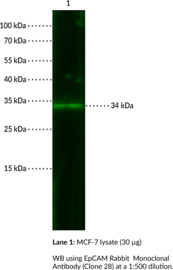
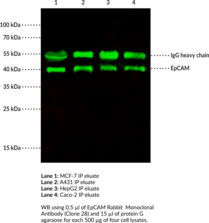
Epithelial cell adhesion molecule (EpCAM) is a transmembrane glycoprotein.1 It is composed of an extracellular domain (EpEX) that contains an N-domain, a thyroglobulin type-IA domain, and a C-domain, a transmembrane domain, and an intracellular domain (EpIC). EpEX undergoes proteolytic cleavage by disintegrin and metalloproteinase domain-containing protein 17 (ADAM17/TACE) to release soluble EpEX, and γ-secretase cleaves EpCAM at two sites to release a soluble extracellular amyloid-β-like fragment and EpIC. EpCAM is ubiquitously expressed in epithelial tissues but is also found in stem and progenitor cells and tight junctions.2,3 It is involved in cell adhesion, transport, polarity, proliferation, and motility and signals through novel PKC (nPKC), Wnt, and embryonic RAS (ERAS)/Akt pathways.2 Knockdown of EPCAM decreases proliferation, migration, and invasion of breast cancer cells in vitro.4 Epcam-/- mice develop congenital tufting enteropathy (CTE), a disease characterized by hemorrhagic diarrhea, colon crypt hyperplasia, intestinal tufts, and villous atrophy.5 Increased protein levels of EpCAM are frequently found in tumors from patients with diverse cancer types.6 Cayman’s EpCAM Rabbit Monoclonal Antibody (Clone 28) can be used for ELISA, ELISA (detection), flow cytometry (FC), immunocytochemistry (ICC), immunofluorescence (IF), immunohistochemistry paraffin (IHC-P), immunoprecipitation (IP), and Western blot (WB) applications. The antibody recognizes EpCAM at 34 kDa from human samples. However, due to glycosylation the antibody may recognize EpCAM at approximately 38-40 kDa.
WARNING This product is not for human or veterinary use.
References & Product Citations
1. Biology and clinical relevance of EpCAM. Cell Stress 3(6), 165-180 (2019).
2. Functions of EpCAM in physiological processes and diseases (Review). Int. J. Mol. Med. 42(4), 1771-1785 (2018).
3. The cell‒cell adhesion molecule EpCAM interacts directly with the tight junction protein claudin-
4. EpCAM is overexpressed in breast cancer and is a potential target for breast cancer gene therapy. Cancer Res. 64(16), 5818-5824 (2004).
5. mTrop1/Epcam knockout mice develop congenital tufting enteropathy through dysregulation of intestinal E-
6. Frequent EpCam protein expression in human carcinomas. Hum. Pathol. 35(1), 122-128 (2004).
Contact Info
Cayman Chemical1180 East Ellsworth RoadAnn Arbor, Michigan 48108 USAToll Free: (800) 364-9897(USA and Canada only)Fax: (734) 971-3640


