
Technical Support & Resources
Visit our FAQ
Contact Us
Toll Free Phone (USA and Canada Only): (888) 526-5351
Direct Phone: (734) 975-3888
Product Categories
Technical Information
- Adipocyte FABP
- A-FABP
- ALBP
- aP2
- Fatty Acid Binding Protein 4
Shipping & Storage Information
Recommended Products
Certificates of Analysis & Batch Specific Data
Provide batch numbers separated by commas to download or request available product inserts, QC sheets, certificates of analysis, data packs, and GC-MS data.
Lipid Resource Center
Discover Products & Resources for Lipid Research
- High-purity lipid standards
- Lipid roles in biology
- Lipids in health & disease
- Lipids for pharmaceutical development
- Protocols, advice, & resources
Product Description
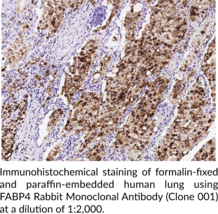
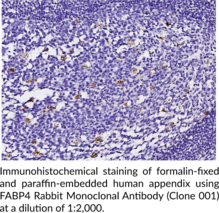
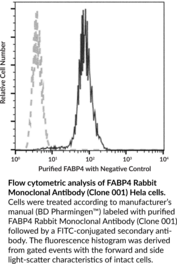
Fatty acid binding protein 4 (FABP4) is a member of the intracellular lipid-binding protein (iLBP) family.1 It is composed of a β-barrel, which forms the lipid-binding site, and two α-helices that form a lid on the β-barrel.2 FABP4 is primarily expressed in adipocytes but has also been found in activated macrophages.3,4 It is involved in lipid transport and metabolism, insulin resistance, and angiogenesis, and its expression is induced by long-chain fatty acids and peroxisome proliferator-activated receptor γ (PPARγ) agonists.1,5,6,7,8 Knockout of Fabp4 prevents the development of atherosclerosis in ApoE-/- mice and increases body weight gain and insulin sensitivity in ob/ob mice.9,5 Serum levels of FABP4 are increased in patients with colorectal cancer, and serum and synovial fluid levels of FABP4 are increased in patients with rheumatoid arthritis.10,7 Cayman’s FABP4 Rabbit Monoclonal Antibody (Clone 001) can be used for flow cytometry (FC) and immunohistochemistry-paraffin (IHC-P) applications.
WARNING This product is not for human or veterinary use.
References & Product Citations
1. New insights into the structure and function of fatty acid-
2. Structural properties of the adipocyte lipid binding protein. Biochim. Biophys. Acta 1441(2-3), 106-116 (1999).
3. Human adipocyte lipid-
4. Absence of adipocyte fatty acid binding protein prevents the development of accelerated atherosclerosis in hypercholesterolemic mice. The FASEB Journal 15(10), 1774-1776 (2001).
5. Improved glucose and lipid metabolism in genetically obese mice lacking aP2. Endocrinology 141(9), 3388-3396 (2000).
6. Uncoupling of obesity from insulin resistance through a targeted mutation in aP2, the adipocyte fatty acid binding protein. Science 274(5291), 1377-1379 (1996).
7. FABP4 secreted by M1-
8. Expression of preoxisome proliferator-
9. Ibuprofen suppresses plaque pathology and inflammation in a mouse model for Alzheimer’s disease. J. Neurosci. 20(15), 5709-5714 (2000).
10. High expression of FABP4 and FABP6 in patients with colorectal cancer. World J. Surg. Oncol. 17(1), 171 (2019).
Contact Info
Cayman Chemical1180 East Ellsworth RoadAnn Arbor, Michigan 48108 USAToll Free: (800) 364-9897(USA and Canada only)Fax: (734) 971-3640


