
Technical Support & Resources
Visit our FAQ
Contact Us
Toll Free Phone (USA and Canada Only): (888) 526-5351
Direct Phone: (734) 975-3888
Product Categories
Technical Information
- hGC-1
- Human Granulocyte Colony-stimulating Factor-stimulated Clone 1
- Olfactomedin 4
Shipping & Storage Information
Recommended Products
Certificates of Analysis & Batch Specific Data
Provide batch numbers separated by commas to download or request available product inserts, QC sheets, certificates of analysis, data packs, and GC-MS data.

Visit Our Cancer Resource Center
Find Tools & Resources to Study the Hallmarks of Cancer
- Cancer cell signaling & regulation
- Cancer metabolism
- Tumor microenvironment
Product Description
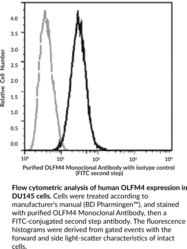
Olfactomedin 4 (OLFM4) is a secreted olfactomedin domain-containing glycoprotein with roles in cell growth and apoptosis, tumor initiation and progression, and innate immunity.1,2,3 It is composed of an N-terminal coil-coil domain and a C-terminal olfactomedin domain and expressed in the small intestine, colon, prostate, stomach, and bone marrow, as well as macrophages and in neutrophils within specific granules.4,1 Olfm4 knockdown decreases renal cell apoptosis and increases survival in a mouse model of sepsis and increased blood levels of OLFM4 are associated with poor outcomes in patients with sepsis.2 Levels of OLFM4 are increased in intestinal tissue isolated from neonatal patients with necrotizing enterocolitis.1 OLFM4 levels are decreased in metastatic cervical cancer tissues compared with adjacent non-cancerous tissues isolated from patients with cervical cancer.3 Cayman’s OLFM4 Monoclonal Antibody can be used for ELISA and flow cytometry (FC) applications.
WARNING This product is not for human or veterinary use.
References & Product Citations
1. Increased expression of OLFM4 and lysozyme during necrotizing enterocolitis in neonates: An observational research study. BMC Pediatr. 22(1), 192 (2022).
2. Juvenile OLFM4-
3. OLFM4 inhibits epithelial–mesenchymal transition and metastatic potential of cervical cancer cells. Oncol. Res. 27(7), 763-771 (2019).
4. Stem cell marker olfactomedin 4: Critical appraisal of its characteristics and role in tumorigenesis. Cancer Metastasis Rev. 29(4), 761-775 (2010).
Contact Info
Cayman Chemical1180 East Ellsworth RoadAnn Arbor, Michigan 48108 USAToll Free: (800) 364-9897(USA and Canada only)Fax: (734) 971-3640


