
Technical Support & Resources
Visit our FAQ
Contact Us
Toll Free Phone (USA and Canada Only): (888) 526-5351
Direct Phone: (734) 975-3888
Product Categories
Technical Information
- Interferon Alpha/Beta Receptor 1
- Interferon α/β Receptor 1
- CRF2-1
- CRF2 member 1
- Cytokine Receptor Class-II Member 1
- Cytokine Receptor Family 2 Member 1
- Type I IFN Receptor 1
- Type I Interferon Receptor 1
Shipping & Storage Information
Recommended Products
Certificates of Analysis & Batch Specific Data
Provide batch numbers separated by commas to download or request available product inserts, QC sheets, certificates of analysis, data packs, and GC-MS data.

Visit Our Cancer Resource Center
Find Tools & Resources to Study the Hallmarks of Cancer
- Cancer cell signaling & regulation
- Cancer metabolism
- Tumor microenvironment
Product Description
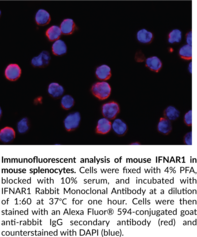
α/β receptor 1 (IFNAR1), also known as type I IFN receptor 1, is a class II helical cytokine receptor involved in the antiviral response.1 It is composed of an extracellular domain, which contains four fibronectin type III subdomains, a transmembrane domain, and an intracellular domain, which contains a tyrosine kinase 2 (TYK2) phosphorylation site, and forms a heterodimer with IFNAR2.2 It is ubiquitously expressed and binds to type I IFNs, including IFN-α, IFN-β, and IFN-ω, which, upon binding, together with IFNAR2 signals through JAK1, TYK2, and various STATs.3 Knockout of Ifnar1 sensitizes fibroblasts to severe acute respiratory syndrome coronavirus 2 (SARS-CoV-2) infection in vitro and has commonly been used as an immunosuppressive model to study viral infections in vivo.4,5 SNPs in IFNAR1 are associated with increased risk of viral infections, lung cancer, multiple sclerosis, and cerebral malaria, as well as adverse reactions to vaccinations.1 Cayman’s IFNAR1 Rabbit Monoclonal Antibody (Clone 110) can be used for immunocytochemistry (ICC) and immunofluorescence (IF) applications.
WARNING This product is not for human or veterinary use.
References & Product Citations
1. Structural integrity with functional plasticity: What type I IFN receptor polymorphisms reveal. J. Leukoc. Biol. 108(3), 909-924 (2020).
2. Interferons at age 50: Past, current and future impact on biomedicine. Nat. Rev. Drug Discov. 6(12), 975-990 (2007).
3. The interferons and their receptors -
4. Inborn errors of type I IFN immunity in patients with life-
5. Modeling arboviral infection in mice lacking the interferon alpha/beta receptor. Viruses 11(1), 35 (2019).
Contact Info
Cayman Chemical1180 East Ellsworth RoadAnn Arbor, Michigan 48108 USAToll Free: (800) 364-9897(USA and Canada only)Fax: (734) 971-3640


