
Technical Support & Resources
Visit our FAQ
Contact Us
Toll Free Phone (USA and Canada Only): (888) 526-5351
Direct Phone: (734) 975-3888
Product Categories
Application
Technical Information
- IFN-γ-inducing Factor
- IGIF
- IL-18
- IL-1γ
- Interferon Gamma-inducing Factor
- Interleukin-1γ
Shipping & Storage Information
Recommended Products
Certificates of Analysis & Batch Specific Data
Provide batch numbers separated by commas to download or request available product inserts, QC sheets, certificates of analysis, data packs, and GC-MS data.
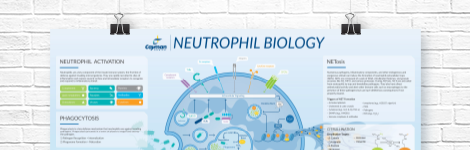
Neutrophil Biology Wall Poster
Explore how neutrophils shape the immune response in health and disease. This poster highlights neutrophil pathogen defense mechanisms, including phagocytosis, degranulation, and NETosis, as well as neutrophil roles in inflammation and NET-associated pathologies.
DOWNLOAD NOWProduct Description
Interleukin-18 (IL-18) is a pro-inflammatory cytokine and member of the IL-1 cytokine family.1,2 It is synthesized as an inactive precursor peptide, pro-IL-18, in macrophages, dendritic cells, Kupffer cells, keratinocytes, chondrocytes, synovial fibroblasts, and osteoblasts, where it is cleaved by inflammasome-activated caspase-1 to form active IL-18.1,3 Active IL-18 is released from cells during pyroptosis, but inactive pro-IL-18 can also be secreted from dying cells and processed extracellularly by neutrophil proteinase 3, human chymase, and granzyme B.3 IL-18 binds to IL-18 receptors (IL-18Rs) on the surface of T helper 1 (Th1) and non-polarized T cells, natural killer (NK) cells, and NKT cells to induce intracellular signaling and IFN-γ production in response to viral, bacterial, or parasitic infection.2,3 It also binds to mast cells and basophils in conjunction with IL-3 to induce the production of IL-4 and IL-13, respectively. Inhibition of IL-18 with anti-IL-18 sera decreases survival in various mouse models of infection.3 Circulating levels of IL-18 are increased in patients with macrophage activation syndrome (MAS) or hemophagocytic lymphohistiocytosis (HLH).4 Cayman’s IL-18 Rabbit Monoclonal Antibody (Clone 011) can be used for ELISA and ELISA (CAP).
WARNING This product is not for human or veterinary use.
References & Product Citations
1. IL-
2. Interleukin-
3. IL‐18 and infections: Is there a role for targeted therapies? J. Cell. Physiol. 236(3), 1638-1657 (2020).
4. Macrophage activation syndrome in the era of biologic therapy. Nat. Rev. Rheumatol. 12(5), 259-268 (2016).
Contact Info
Cayman Chemical1180 East Ellsworth RoadAnn Arbor, Michigan 48108 USAToll Free: (800) 364-9897(USA and Canada only)Fax: (734) 971-3640


