
Technical Support & Resources
Information provided in the product description is from published literature. Due to the nature of scientific experimentation, your results (e.g., selectivity and effective concentrations) or specific application for this product may differ. If you have questions about how this product fits your application, please contact our technical support staff.
Visit our FAQ
Contact Us
Toll Free Phone (USA and Canada Only): (888) 526-5351
Direct Phone: (734) 975-3888
Product Categories
Application
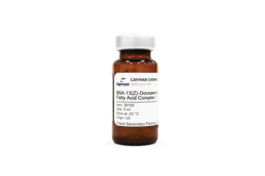
BSA-13(Z)-Docosenoate Monounsaturated Fatty Acid Complex (1 mM)
Item No. 39150
Technical Information
- Bovine Serum Albumin-13(Z)-Docosenoate
- BSA-Erucate
Shipping & Storage Information
Recommended Products
Certificates of Analysis & Batch Specific Data
Provide batch numbers separated by commas to download or request available product inserts, QC sheets, certificates of analysis, data packs, and GC-MS data.
Lipid Resource Center
Discover Products & Resources for Lipid Research
- High-purity lipid standards
- Lipid roles in biology
- Lipids in health & disease
- Lipids for pharmaceutical development
- Protocols, advice, & resources
Product Description
BSA-13(Z)-Docosenoate Monounsaturated Fatty Acid Complex (1 mM) is composed of 13(Z)-docosenoic acid (Item Nos. 90175) and fatty acid-free bovine serum albumin (BSA) at an approximately 6:1 molar ratio of 13(Z)-docosenoate:BSA. It can be used for efficient fatty acid delivery to cells in culture for the purpose of monitoring lipid metabolism, including fatty acid oxidation, and inflammatory signaling pathways.1,2 It can also be used to study the effect of 13(Z)-docosenoic acid on cardiac electrophysiology and myocardial lipidosis.3,4 Cayman’s BSA-13(Z)-Docosenoate Monounsaturated Fatty Acid Complex (1 mM) is suitable for use in short-term cell culture applications (acute treatment to 18 hours); however, for long-term applications (25+ hours) the product should be filter-sterilized using a 0.2 µm filter and sterile receptacle, which will not affect its performance. For best results, it is recommended that this product be used in conjunction with Cayman’s BSA Control for BSA-Fatty Acid Complexes (1 mM) (Item No. 34932), prepared with fatty acid-free BSA.
WARNING This product is not for human or veterinary use.
References & Product Citations
1. Cell culture models of fatty acid overload: Problems and solutions. Biochim. Biophys. Acta Mol. Cell Biol. Lipids 1863(2), 143-151 (2018).
2. In vitro conversion of erucic acid by microsomes and mitochondria from liver, kidneys and heart of rats. Lipids 14(3), 268-273 (1978).
3. Comparative study on the effects of exogenous palmitate and erucate on intracellular electric properties of cultured beating heart cells. J. Mol. Cell. Cardiol. 11(8), 755-767 (1979).
4. Erucic acid aggravates cardiac fibrosis after myocardial infarction by CD36-
Contact Info
Cayman Chemical1180 East Ellsworth RoadAnn Arbor, Michigan 48108 USAToll Free: (800) 364-9897(USA and Canada only)Fax: (734) 971-3640


