
Features
- Enables you to visualize the interaction between receptor PD1 and its ligand PD-L1 in tissues with intact morphology
- Includes primary Navenibodies specific to PD1 and PD-L1 and all other reagents needed to run the assay
- Chromogenic detection and bright-field read-out
Technical Support & Resources
Visit our FAQ
Contact Us
Toll Free Phone (USA and Canada Only): (888) 526-5351
Direct Phone: (734) 975-3888
Product Categories
Product Type
Application
Technical Information
Shipping & Storage Information
Recommended Products
Certificates of Analysis & Batch Specific Data
Provide batch numbers separated by commas to download or request available product inserts, QC sheets, certificates of analysis, data packs, and GC-MS data.

Visit Our Cancer Resource Center
Find Tools & Resources to Study the Hallmarks of Cancer
- Cancer cell signaling & regulation
- Cancer metabolism
- Tumor microenvironment
Product Description
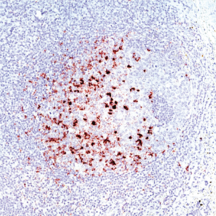
The PD1/PD-L1 HRP is an in situ proximity ligation assay kit for chromogenic detection of the interaction of PD1 and PD-L1. This is the first commercial assay for detecting the interaction in situ, the kit gives a high signal-to-noise ratio and has an out-standing specificity. The kit has been validated on FFPE human tissue samples.
The kit is based on our Naveni™ Proximity Ligation Technology, with two Navenibodies conjugated to proprietary oligo arms. The technology ensures specific and sensitive detection; learn more about Naveni technology.
One Navenibody binds the PD1 protein, and the other Navenibody binds PD-L1 . Probes in close proximity will give a strong and distinct signal, creating a specific and sensitive detection method for the interaction between PD1 and PD-L1.
Included in the kit:
• Navenibody targeting human PD1 protein based on clone EH33 CST
• Navenibody targeting human PD-L1 protein based on clone SP142 Abcam RabMAb®
• HRP substrate, red precipitating reaction product
• Buffers for blocking and dilutions, and all detection reagents
• The Navenibody solution has a working volume of 4000 µl (sufficient for approximately 100 reactions)
Not included in the kit:
• VectaMount® Express Mounting Medium (H-5700-60) from Vector Laboratories (required for optimal signal intensity).
• Isopropanol 99.5%
• Endogenous quenching solution
• TBS and TBS-T-Tris-buffered saline and Tris-buffered saline supplemented with 0.05% Tween, respectively
Also available with AP Substrate (Item No. 39215)
Find better prognostic biomarkers
PD1 PD-L1 signaling has with immune checkpoint inhibitors proven to be significant in cancer progression and treatment. Despite the recent success of immune checkpoint inhibitors, many patients do not benefit from these therapies, and predictive biomarkers improving patient stratification are needed.PD-L1 IHC is commonly used as a biomarker, but the correlation between PD-L1 expression levels and PD1/PD-L1 interaction is not always linear.
Naveni PPI
Proteins perform a wide range of functions and are the closest way to understand biology. Proteins are also key targets in both health and disease. When proteins carry out their function, they interact with other proteins or molecules. To understand biological pathways and mode of action, we need to get a deeper insight into protein functions and how the protein interacts. Detecting the interactions has until now been either complicated, unspecific, or insensitive. The Naveni™ Proximity Ligation Technology enables visualization of protein-protein interaction using one primary antibody for each target protein, without the need to disrupt the tissue microenvironment.
WARNING This product is not for human or veterinary use.
Contact Info
Cayman Chemical1180 East Ellsworth RoadAnn Arbor, Michigan 48108 USAToll Free: (800) 364-9897(USA and Canada only)Fax: (734) 971-3640


