
Technical Support & Resources
Information provided in the product description is from published literature. Due to the nature of scientific experimentation, your results (e.g., selectivity and effective concentrations) or specific application for this product may differ. If you have questions about how this product fits your application, please contact our technical support staff.
Visit our FAQ
Contact Us
Toll Free Phone (USA and Canada Only): (888) 526-5351
Direct Phone: (734) 975-3888
Product Categories
Application

Technical Information
- DiOC2(3)
- DOC
- NK 85
Shipping & Storage Information
Recommended Products
Certificates of Analysis & Batch Specific Data
Provide batch numbers separated by commas to download or request available product inserts, QC sheets, certificates of analysis, data packs, and GC-MS data.
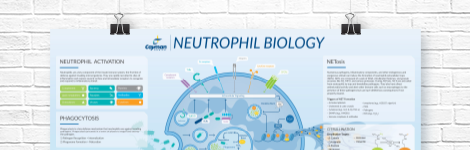
Neutrophil Biology Wall Poster
Explore how neutrophils shape the immune response in health and disease. This poster highlights neutrophil pathogen defense mechanisms, including phagocytosis, degranulation, and NETosis, as well as neutrophil roles in inflammation and NET-associated pathologies.
DOWNLOAD NOWProduct Description
3,3′-Diethyloxacarbocyanine (DiOC2(3)) is a cationic fluorescent dye that has been used to monitor mammalian and bacterial membrane potential.1,2,3,4 Upon cell hyperpolarization, it enters cells, and exhibits a decrease in fluorescence intensity and shift in emission from 530 nm to 670 nm upon excitation at 488 nm.4 DiOC2(3) selectively inhibits bovine heart mitochondrial complex I, also known as NADH dehydrogenase (IC50 = 9 µM), over bovine heart mitochondrial complex IV, also known as cytochrome c oxidase, and P. denitrificans mitochondrial complex I but activates bovine heart mitochondrial complex II, also known as succinate dehydrogenase, at 10 µM.5
WARNING This product is not for human or veterinary use.
References & Product Citations
1. Studies on the mechanism by which cyanine dyes measure membrane potential in red blood cells and phosphatidylcholine vesicles. Biochemistry 13(16), 3315-3330 (1974).
2. A rapid microtiter plate assay for measuring the effect of compounds on Staphylococcus aureus membrane potential. J. Microbiol. Methods 83(2), 254-256 (2010).
3. Accurate flow cytometric membrane potential measurement in bacteria using diethyloxacarbocyanine and a ratiometric technique. Cytometry 35(1), 55-63 (1999).
4. Evaluation of Escherichia coli viability by flow cytometry: A method for determining bacterial responses to antibiotic exposure. Cytometry B Clin. Cytom. 88(3), 149-153 (2015).
5. Inhibition of mitochondrial and Paracoccus denitrificans NADH-
Contact Info
Cayman Chemical1180 East Ellsworth RoadAnn Arbor, Michigan 48108 USAToll Free: (800) 364-9897(USA and Canada only)Fax: (734) 971-3640


