
Technical Support & Resources
Visit our FAQ
Contact Us
Toll Free Phone (USA and Canada Only): (888) 526-5351
Direct Phone: (734) 975-3888
Product Categories
Influenza A H1N1 (Swine Flu 2009) HA Monoclonal Antibody (Clone 9G1G8)
Item No. 39541
Technical Information
- Influenza A H1N1 (Swine Flu 2009) Hemagglutinin
Shipping & Storage Information
Recommended Products
Certificates of Analysis & Batch Specific Data
Provide batch numbers separated by commas to download or request available product inserts, QC sheets, certificates of analysis, data packs, and GC-MS data.
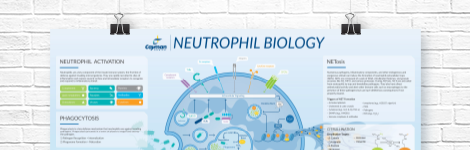
Neutrophil Biology Wall Poster
Explore how neutrophils shape the immune response in health and disease. This poster highlights neutrophil pathogen defense mechanisms, including phagocytosis, degranulation, and NETosis, as well as neutrophil roles in inflammation and NET-associated pathologies.
DOWNLOAD NOWProduct Description
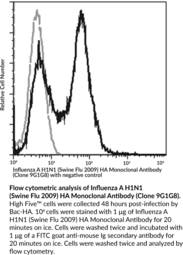
Influenza A H1N1 HA is a type I membrane glycoprotein involved in receptor binding and virus-host cell fusion.1,2 It is produced as a precursor protein, HA0, which is composed of a stalk and head domain and forms homotrimers on the viral surface.3,1 The HA0 precursor is cleaved into subunits, HA1 and HA2, which are responsible for host cell surface receptor binding and endosomal membrane fusion, respectively, and this cleavage is required for endosomal fusion.1 For influenza A and influenza B, which are low pathogenic influenza viruses, cleavage occurs via trypsin-like proteases, such as transmembrane serine protease 2 (TMRPSS2), which is essential for influenza A HA, but not influenza B HA, cleavage.4,5,6 Cleaved influenza A H1N1 HA binds to terminal α2,6- or α2,3-sialic acids on glycoproteins or glycolipids on the host cell surface via the receptor-binding domain in the HA1 subunit, which triggers endocytosis of the virus and trafficking of the vesicle into the endosome.3,7,8 The low pH environment of the endosome triggers viral rearrangement into a prefusion conformation, and the HA2 subunit facilitates fusion with the endosomal membrane to release viral ribonucleoproteins into the cytosol where they are relocated to the nucleus for viral replication.3 Cayman’s Influenza A H1N1 (Swine Flu 2009) HA Monoclonal Antibody (Clone 9G1G8) can be used for ELISA and Western blot (WB) applications.
WARNING This product is not for human or veterinary use.
References & Product Citations
1. Hemagglutinin stability and its impact on influenza A virus infectivity, pathogenicity, and transmissibility in avians, mice, swine, seals, ferrets, and humans. Viruses 13(5), 746 (2021).
2. Influenza hemagglutinin and neuraminidase membrane glycoproteins. The Journal of Biological Chemisty 285(37), 28403-28409 (2010).
3. Influenza A virus cell entry, replication, virion assembly and movement. Front. Immunol. 9, 1581 (2018).
4. TMPRSS2 independency for haemagglutinin cleavage in vivo differentiates influenza B virus from influenza A virus. Sci. Rep. 6, 29430 (2016).
5. Hemagglutinin activating host cell proteases provide promising drug targets for the treatment of influenza A and B virus infections. Vaccine 30(51), 7374-7380 (2012).
6. TMPRSS2 is the major activating protease of influenza A virus in primary human airway cells and influenza B virus in human type II pneumocytes. J. Virol. 93(21), e00649-00619 (2019).
7. Host and viral determinants of influenza A virus species specificity. Nat. Rev. Microbiol. 17(2), 67-81 (2019).
8. Structural basis for receptor specificity of influenza B virus hemagglutinin. Proc. Natl. Acad. Sci. USA 104(43), 16874-16879 (2007).
Contact Info
Cayman Chemical1180 East Ellsworth RoadAnn Arbor, Michigan 48108 USAToll Free: (800) 364-9897(USA and Canada only)Fax: (734) 971-3640


