
Technical Support & Resources
Visit our FAQ
Contact Us
Toll Free Phone (USA and Canada Only): (888) 526-5351
Direct Phone: (734) 975-3888
Product Categories
Product Type
Application
Technical Information
- NADPH-dependent Thioredoxin Reductase 2
- TrxR2
- Txnrd2
Shipping & Storage Information
Recommended Products
Certificates of Analysis & Batch Specific Data
Provide batch numbers separated by commas to download or request available product inserts, QC sheets, certificates of analysis, data packs, and GC-MS data.

Visit Our Cancer Resource Center
Find Tools & Resources to Study the Hallmarks of Cancer
- Cancer cell signaling & regulation
- Cancer metabolism
- Tumor microenvironment
Product Description
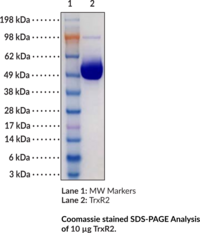
Thioredoxin reductase 2 (TrxR2) is an oxidoreductase encoded by the TXNRD2 gene in humans and a member of the antioxidant thioredoxin system.1 It exists as a homodimer and contains a dimer interface domain, FAD- and NADPH-binding domains, an N-terminal redox catalytic site, and a C-terminal selenocysteine residue, which is essential for the catalytic activity of TrxR2.1,2 TrxR2 is ubiquitously expressed and localizes primarily to the mitochondria.3 It catalyzes the NADPH-dependent reduction of oxidized thioredoxin 2 (Trx2), restoring the disulfide reductase function of Trx2, which reduces peroxiredoxin-3 (Prx3) dimers.4,5 TrxR2 has roles in the maintenance of mitochondrial integrity and redox homeostasis in the aging heart and in the regulation of chondrocyte viability, proliferation, and differentiation.2 Genome-wide deletion of Txnrd2 is embryonic lethal in mice.6 TXNRD2 expression and TrxR2 protein levels are increased in bone biopsies from patients with osteosarcoma that later progress to metastatic disease.7 SNPs in TXNRD2 are associated with serum markers of selenium status in patients with advanced- or high-stage, but not localized low-grade, prostate cancer.8 Cayman’s Thioredoxin Reductase 2 (human, recombinant) protein can be used for enzyme activity assays.
WARNING This product is not for human or veterinary use.
References & Product Citations
1. Thioredoxin reductase. Biochem. J. 346(Pt. 1), 1-8 (2000).
2. Significance of the mitochondrial thioredoxin reductase in cancer cells: An update on role, targets and inhibitors. Free Radic. Biol. Med. 127, 62-79 (2018).
3. Two thioredoxin reductases, trxr-
4. Thioredoxin and thioredoxin reductase: Current research with special reference to human disease. Biochem. Biophys. Res. Commun. 396(1), 120-124 (2010).
5. Anti-
6. Essential role for mitochondrial thioredoxin reductase in hematopoiesis, heart development, and heart function. Mol. Cell. Biol. 24(21), 9414-9423 (2004).
7. Auranofin is a potent suppressor of osteosarcoma metastasis. Oncotarget 7(1), 831-844 (2016).
8. Polymorphisms in thioredoxin reductase and selenoprotein K genes and selenium status modulate risk of prostate cancer. PLoS One 7(11), e48709 (2012).
Contact Info
Cayman Chemical1180 East Ellsworth RoadAnn Arbor, Michigan 48108 USAToll Free: (800) 364-9897(USA and Canada only)Fax: (734) 971-3640


