
Technical Support & Resources
Visit our FAQ
Contact Us
Toll Free Phone (USA and Canada Only): (888) 526-5351
Direct Phone: (734) 975-3888
Product Categories
Application
Technical Information
- Glutathione Peroxidase 2 (Gastrointestinal)
- GSHPX2
- GSHPX-GI
Shipping & Storage Information
Recommended Products
Certificates of Analysis & Batch Specific Data
Provide batch numbers separated by commas to download or request available product inserts, QC sheets, certificates of analysis, data packs, and GC-MS data.

Visit Our Cancer Resource Center
Find Tools & Resources to Study the Hallmarks of Cancer
- Cancer cell signaling & regulation
- Cancer metabolism
- Tumor microenvironment
Product Description
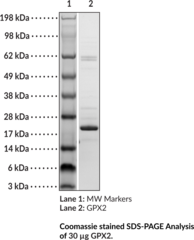
Glutathione peroxidase 2 (GPX2) is a selenocysteine-containing glutathione peroxidase that protects cells from oxidative damage.1 It is a homotetramer and has an active site containing selenocysteine, glutamine, asparagine, and tryptophan.2,3 mRNA encoding GPX2 has been found predominantly in the liver and gastrointestinal tract and is localized to the nucleus and cytosol, and GPX2 can reduce organic peroxides, such as hydrogen-, tert-butyl-, or cumene hydroperoxide.4,5,3 It catalyzes the reduction of these reactive oxygen species (ROS) to water or their corresponding non-toxic lipid alcohols by converting glutathione (GSH) to oxidized glutathione (GSSH), reducing intracellular oxidative stress.5 GPX2 knockout increases inflammation and tumor growth in a dextran sulfate sodium (DSS) mouse model of inflammation-associated colon carcinogenesis.6 Its levels are increased in undifferentiated basal cells, but absent in lineage-restricted luminal progenitors and luminal cells, in normal human breast tissue.7 GPX2 levels are decreased in triple-negative- and HER2+ breast cancers, but not in luminal breast cancers, and are negatively correlated with patient survival.8 Cayman's GPX2 (human, recombinant) protein can be used for enzyme activity assays.
WARNING This product is not for human or veterinary use.
References & Product Citations
1. Biological significance of phospholipid hydroperoxide glutathione peroxidase (PHGPx, GPx4) in mammalian cells. Free Radic. Biol. Med. 34(2), 145-169 (2003).
2. GPX4 at the crossroads of lipid homeostasis and ferroptosis. Proteomics 19(18), e1800311 (2019).
3. Characterization of recombinant human gastrointestinal glutathione peroxidase mutant produced in Escherichia coli. Free Radic. Res. 49(3), 228-235 (2015).
4. Expression, characterization, and tissue distribution of a new cellular selenium-
5. The beginning of GPX2 and 30 years later. Free Radic. Biol. Med. 188, 419-433 (2022).
6. Physiological functions of GPx2 and its role in inflammation-
7. Glutathione-
8. Redox signaling by glutathione peroxidase 2 links vascular modulation to metabolic plasticity of breast cancer. Proc. Natl. Acad. Sci. USA 119(8), e2107266119 (2022).
Contact Info
Cayman Chemical1180 East Ellsworth RoadAnn Arbor, Michigan 48108 USAToll Free: (800) 364-9897(USA and Canada only)Fax: (734) 971-3640


