
Technical Support & Resources
Visit our FAQ
Contact Us
Toll Free Phone (USA and Canada Only): (888) 526-5351
Direct Phone: (734) 975-3888
Product Categories
Product Type
Application
Thioredoxin Glutathione Reductase (Schistosoma mansoni, recombinant)
Item No. 39632
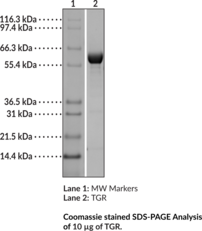
Technical Information
- TGR
Shipping & Storage Information
Recommended Products
Certificates of Analysis & Batch Specific Data
Provide batch numbers separated by commas to download or request available product inserts, QC sheets, certificates of analysis, data packs, and GC-MS data.
Neutrophil Biology Wall Poster
Explore how neutrophils shape the immune response in health and disease. This poster highlights neutrophil pathogen defense mechanisms, including phagocytosis, degranulation, and NETosis, as well as neutrophil roles in inflammation and NET-associated pathologies.
DOWNLOAD NOWProduct Description
Thioredoxin glutathione reductase (TGR) is a selenocysteine-containing oxidoreductase flavoenzyme that protects Schistosoma, the genus of blood flukes that causes schistosomiasis, and other helminth parasites from host-induced oxidative damage.1,2 It is a homodimer that contains an N-terminal glutathione reductase domain, an FAD- and NADPH- binding site, and a thioredoxin domain near the C-terminus, and it can reduce both DTNB and oxidized glutathione (GSSH).2 TGR catalyzes NADPH- and FAD-dependent reduction of oxidized thioredoxin (Trx), glutathione (GSH), and glutaredoxin (Grx), which mitigate the effects of reactive oxygen and nitrogen species released by host neutrophils and macrophages that can damage intracellular proteins and lipids.3 Cayman's TGR (Schistosoma mansoni, recombinant) protein can be used for enzyme activity assays.
WARNING This product is not for human or veterinary use.
References & Product Citations
1. The disulfide redox system of Schistosoma mansoni and the importance of a multifunctional enzyme, thioredoxin glutathione reductase. Mol. Biochem. Parasitol. 121(1), 129-139 (2002).
2. Glutathione reductase and thioredoxin reductase at the crossroad: The structure of Schistosoma mansoni thioredoxin glutathione reductase. Proteins 72(3), 936-945 (2008).
3. Thioredoxin glutathione reductase-
Contact Info
Cayman Chemical1180 East Ellsworth RoadAnn Arbor, Michigan 48108 USAToll Free: (800) 364-9897(USA and Canada only)Fax: (734) 971-3640


