
Technical Support & Resources
Visit our FAQ
Contact Us
Toll Free Phone (USA and Canada Only): (888) 526-5351
Direct Phone: (734) 975-3888
Product Categories
ACSL3 (human, recombinant; aa 45-720)
Item No. 39990
Technical Information
- ACS3
- Fatty Acid CoA Ligase 3
- LACS 3
- Long-chain Acyl-CoA Synthetase 3
- Long-chain Fatty Acid-CoA Ligase 3
Shipping & Storage Information
Recommended Products
Certificates of Analysis & Batch Specific Data
Provide batch numbers separated by commas to download or request available product inserts, QC sheets, certificates of analysis, data packs, and GC-MS data.
Lipid Resource Center
Discover Products & Resources for Lipid Research
- High-purity lipid standards
- Lipid roles in biology
- Lipids in health & disease
- Lipids for pharmaceutical development
- Protocols, advice, & resources
Product Description
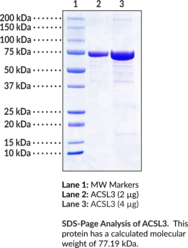
Long-chain acyl-CoA synthetase 3 (ACSL3) is an enzyme involved in lipid biosynthesis and fatty acid degradation.1 It is composed of short N- and C-terminal domains surrounding an AMP-binding domain.2 It is expressed in the brain and prostate and localizes to the endoplasmic reticulum, mitochondria, and lipid droplets.1 ACSL3 is activated by a variety of factors, including peroxisome proliferator-activated receptor δ (PPARδ), octamer-binding transcription factor 1 (Oct1), and the liver X receptor (LXR), among others. ACSL3 converts free monounsaturated long-chain fatty acids into fatty acyl-CoA esters, which are used as substrates for phospholipid and glycerolipid biosynthesis or transported into the mitochondria to be degraded via fatty acid β-oxidation for use as an energy source.1,3,4 ACSL3-dependent conversion of exogenous MUFAs into fatty acyl-CoA esters can induce resistance to ferroptotic cell death by displacing PUFAs and preventing the accumulation of lipid reactive oxygen species (ROS) in the plasma membrane.3,5 ACSL3 is required for tumor cell survival in non-small cell lung cancer (NSCLC) mouse xenograft models, including those expressing K-Ras containing the glycine-to-aspartate activating mutation at position 12 (K-RasG12D).6 It is also highly expressed in tumor tissues isolated from patients with early-stage NSCLC. In contrast, homozygous deletion of ACSL3 is associated with an increased risk of metastasis or recurrence in patients with triple-negative breast cancer (TNBC) receiving adjuvant chemotherapy.7 Cayman’s ACSL3 (human, recombinant; aa 45-720) protein can be used for ELISA, enzyme activity assay, and Western blot applications.
WARNING This product is not for human or veterinary use.
References & Product Citations
1. ACSL family: The regulatory mechanisms and therapeutic implications in cancer. Eur. J. Pharmacol. 909, 174397 (2021).
2. The N-
3. The cell biology of ferroptosis. Nat. Rev. Mol. Cell Biol. (2024).
4. ACSL3 and ACSL4, distinct roles in ferroptosis and cancers. Cancers (Basel) 14(23), 5896 (2022).
5. Exogenous monounsaturated fatty acids promote a ferroptosis-
6. Fatty acid oxidation mediated by acyl-
7. Targeted exome sequencing of Korean triple-
Contact Info
Cayman Chemical1180 East Ellsworth RoadAnn Arbor, Michigan 48108 USAToll Free: (800) 364-9897(USA and Canada only)Fax: (734) 971-3640


