
Technical Support & Resources
Visit our FAQ
Contact Us
Toll Free Phone (USA and Canada Only): (888) 526-5351
Direct Phone: (734) 975-3888
Product Categories
Product Type
Technical Information
- Aromatic α-keto Acid Reductase
- Cytosolic Malate Dehydrogenase
- MDH1
- Mor2
- Soluble Malate Dehydrogenase
Shipping & Storage Information
Recommended Products
Certificates of Analysis & Batch Specific Data
Provide batch numbers separated by commas to download or request available product inserts, QC sheets, certificates of analysis, data packs, and GC-MS data.

Visit Our Cancer Resource Center
Find Tools & Resources to Study the Hallmarks of Cancer
- Cancer cell signaling & regulation
- Cancer metabolism
- Tumor microenvironment
Product Description
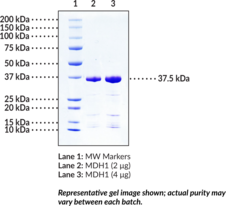
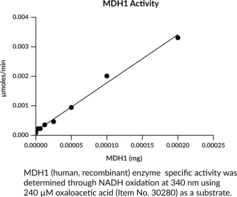
Malate dehydrogenase 1 (MDH1) is an NAD-dependent dehydrogenase and oxidoreductase.1 It is composed of an N-terminal NAD binding domain and a C-terminal substrate binding domain that reversibly catalyzes the conversion of malate to oxaloacetate in the cytosol.1,2 MDH1 functions as a homodimer and is ubiquitously expressed in the human body, functioning as a key metabolic enzyme in glycolysis and the urea acid cycle.1 MDH1 supports increased rates of cancer glycolysis by serving as both a carbon and NAD supplier in lieu of, and in addition to, lactate dehydrogenase (LDH).3 MDH1 expression is amplified in a variety of cancers, including lung squamous cell carcinoma, diffuse B cell lymphoma, as well as bladder and pancreatic cancers, and its higher expression is negatively correlated with patient survival. Oncogenic K-Ras-induced glycosylation of MDH1, but not the mitochondrial MDH2 isoform, stabilizes the substrate-binding domain, increases MDH1 activity, and increases proliferation in pancreatic cancer cells.4 MDH1 activity is increased in brain homogenates from patients with early Alzheimer’s disease compared to brain homogenates from age-matched individuals without Alzheimer's disease.5 Cayman’s Malate Dehydrogenase 1 (human, recombinant) protein can be used for ELISA, enzyme assay, and Western blot (WB) applications.
WARNING This product is not for human or veterinary use.
References & Product Citations
1. Structural characterization of the human cytosolic malate dehydrogenase I. ACS Omega 7(1), 207-214 (2021).
2. Malate dehydrogenases — structure and function. Gen. Physiol. Biophys. 21(3), 257-265 (2002).
3. Cytosolic malate dehydrogenase activity helps support glycolysis in actively proliferating cells and cancer. Oncogene 36(27), 3915-3924 (2017).
4. O-
5. Proteomic identification of HNE-
Contact Info
Cayman Chemical1180 East Ellsworth RoadAnn Arbor, Michigan 48108 USAToll Free: (800) 364-9897(USA and Canada only)Fax: (734) 971-3640


