
Technical Support & Resources
Visit our FAQ
Contact Us
Toll Free Phone (USA and Canada Only): (888) 526-5351
Direct Phone: (734) 975-3888
Product Categories
Product Type
Application
Technical Information
- OPGL
- Osteoclast Differentiation Factor
- Receptor Activator of NF-κB
- Receptor Activator of Nuclear Factor-κB Ligand
- TNF Ligand Superfamily Member 11
- TNFSF11
- TRANCE
- Tumor Necrosis Factor Ligand Superfamily Member 11
Shipping & Storage Information
Recommended Products
Certificates of Analysis & Batch Specific Data
Provide batch numbers separated by commas to download or request available product inserts, QC sheets, certificates of analysis, data packs, and GC-MS data.

Visit Our Cancer Resource Center
Find Tools & Resources to Study the Hallmarks of Cancer
- Cancer cell signaling & regulation
- Cancer metabolism
- Tumor microenvironment
Product Description
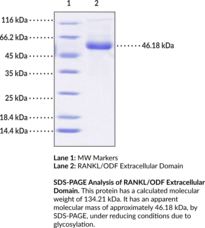
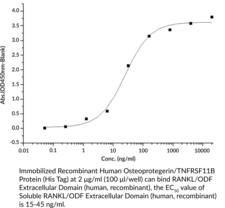
Receptor activator of NF-κB ligand (RANKL), also known as osteoclast differentiation factor (ODF), is a type II transmembrane protein and member of the TNF cytokine family that has roles in bone remodeling, osteoclast differentiation, and immune cell regulation.1,2,3 It is composed of a cytoplasmic domain, a transmembrane domain, and an extracellular binding domain.1,2,3 RANKL is widely expressed but is highly expressed in precursor osteoclasts and maturing lymphocytes.4,5,6 It binds as a soluble homotrimer to its receptor, RANK, to induce signaling via the NF-κB, JNK, ERK, p38, nuclear factor of activated T cells (NFAT), and Akt pathways.7,8,1 RANKL also binds to osteoprotegrin (OPG), which prevents RANKL from activating RANK signaling.9 TNFSF11, the gene encoding RANKL, is differentially transcribed to produce three isoforms: RANKL 1 and RANKL 2, which contain all three domains, and RANKL 3, which contains only the extracellular domain.3 The extracellular domain can also be cleaved from full-length RANKL by the proteases disintegrin and metalloproteinase domain-containing protein 10 (ADAM10) or matrix metalloproteinases-7 (MMP-7) to produce soluble RANKL extracellular domain.6 RANKL 1 promotes osteoclastogenesis while RANKL 3 decreases the ratio of osteoclasts to preosteoclasts. Recombinant RANKL extracellular domain induces dendritic cell aggregation and clustering and increases dendritic cell activation.2 Serum levels of the RANKL extracellular domain are elevated in patients with multiple myeloma and are negatively correlated with prognosis.5 Cayman’s RANKL/ODF Extracellular Domain (human, recombinant) protein can be used for binding and cellular activity assay applications. This protein is a disulfide-linked homodimer. The reduced monomer, composed of RANKL/ODF Extracellular Domain (amino acids 64-245) fused to rabbit IgG Fc at its N-terminus, consists of 181 amino acids and has a calculated molecular weight of 134.21 kDa. As a result of glycosylation, the monomer migrates at approximately 45-55 kDa by SDS-PAGE under reducing conditions.
WARNING This product is not for human or veterinary use.
References & Product Citations
1. A RANKL mutant used as an inter-
2. A homologue of the TNF receptor and its ligand enhance T-
3. Regulation of osteoclastogenesis by three human RANKL isoforms expressed in NIH3T3 cells. Biochem. Biophys. Res. Commun. 314(4), 1021-1027 (2004).
4. α-
5. Soluble receptor activator of nuclear factor κB ligand-
6. RANK-
7. Cyclin-
8. Rubiadin-
9. Expression, purification, and characterization of the human receptor activator of NF-
Contact Info
Cayman Chemical1180 East Ellsworth RoadAnn Arbor, Michigan 48108 USAToll Free: (800) 364-9897(USA and Canada only)Fax: (734) 971-3640


