
Technical Support & Resources
Visit our FAQ
Contact Us
Toll Free Phone (USA and Canada Only): (888) 526-5351
Direct Phone: (734) 975-3888
Product Categories
Product Type
Application
Technical Information
- LTA
- LT-α
- Lymphotoxin-α
- TNFSF1
- Tumor Necrosis Factor-β
- Tumor Necrosis Factor Ligand Superfamily Member 1
Shipping & Storage Information
Recommended Products
Certificates of Analysis & Batch Specific Data
Provide batch numbers separated by commas to download or request available product inserts, QC sheets, certificates of analysis, data packs, and GC-MS data.

Visit Our Cancer Resource Center
Find Tools & Resources to Study the Hallmarks of Cancer
- Cancer cell signaling & regulation
- Cancer metabolism
- Tumor microenvironment
Product Description
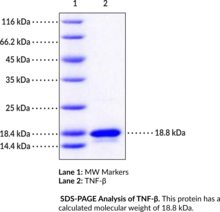
TNF-β, also known as lymphotoxin-α (LT-α), is a cytokine and member of the TNF and TNF receptor (TNFR) cytokine superfamily.1 It is produced as an N-glycosylated peptide that forms soluble bell-shaped homotrimers after signal peptide cleavage.2,3 TNF-β also forms cell surface-anchored heterotrimers with TNF-C, also known as lymphotoxin-β (LT-β).3 It is expressed in T cells, natural killer (NK) cells, and B cells, as well as macrophages. When secreted, TNF-β homotrimers bind to TNF-α receptor 1 (TNFR1) and TNFR2 while TNF-β-LT-β heterotrimers bind to the LT-β receptor.1,4,2 Through activation of these receptors, TNF-β is involved in lymphoid organ development and maintenance, host defense, and inflammatory processes.3,1 TNF-β induces proliferation of fibroblast-like synoviocytes isolated from patients with rheumatoid arthritis, and levels of TNF-β are increased in the serum and synovial fluid of patients with rheumatoid arthritis.5 SNPs in LTA, the gene encoding TNF-β in humans, are associated with various diseases, including systemic lupus erythematosus (SLE) and cancer.6,7 Cayman’s TNF-β (human, recombinant) protein can be used for cellular activity assays. The protein was synthesized from a DNA sequence encoding the mature form of human TNF-β (Leu35-Leu205) with an N-terminal translation-initiating methionine (Met1). The expressed protein consists of 172 amino acids, has a calculated molecular weight of 18.8 kDa, and a predicted N-terminus of Met1.
WARNING This product is not for human or veterinary use.
Contact Info
Cayman Chemical1180 East Ellsworth RoadAnn Arbor, Michigan 48108 USAToll Free: (800) 364-9897(USA and Canada only)Fax: (734) 971-3640


