
Technical Support & Resources
Visit our FAQ
Contact Us
Toll Free Phone (USA and Canada Only): (888) 526-5351
Direct Phone: (734) 975-3888
Product Categories
Technical Information
- ACS4
- FACL4
- Fatty-Acid-Coenzyme A Ligase 4
- Long-chain Acyl-CoA Synthetase 4
- Long-chain Fatty Acid-CoA Ligase 4
Shipping & Storage Information
Recommended Products
Certificates of Analysis & Batch Specific Data
Provide batch numbers separated by commas to download or request available product inserts, QC sheets, certificates of analysis, data packs, and GC-MS data.
Lipid Resource Center
Discover Products & Resources for Lipid Research
- High-purity lipid standards
- Lipid roles in biology
- Lipids in health & disease
- Lipids for pharmaceutical development
- Protocols, advice, & resources
Product Description
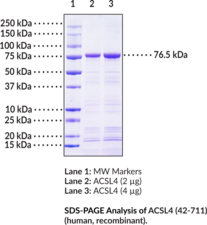
Long-chain acyl-CoA synthetase 4 (ACSL4) is a CoA ligase and member of the ACSL family.1,2 It is composed of an N-terminal membrane-binding domain, a transmembrane domain, an adenosine adaptor region, and a C-terminal catalytic domain.2 ACSL4 is primarily found in the mitochondria, peroxisomes, endoplasmic reticulum (ER), and plasma membrane.1,3 It is generally involved in fatty acid degradation via β-oxidation and lipid synthesis.2 Specifically, ACSL4 ligates 20-chain PUFAs, such as eicosapentaenoic acid (Item Nos. 90110 | 90110.1 | 21908) or arachidonic acid (Item Nos. 90010 | 90010.1 | 10006607), to CoA to form fatty acyl-CoA esters, which are then used for lipid synthesis, plasma membrane repair, and as a carbon source in the citric acid cycle, among other processes.2,4 However, this process can be dysregulated by increased intracellular levels of ferrous iron (Fe2+) and reactive oxygen species (ROS) that further oxidize these PUFA fatty acyl-CoA esters into lipid peroxides that contribute to the development of ferroptosis.3,5,6 Increased expression of ACSL4 is associated with higher cancer staging in patients with prostate cancer.7 Cayman's ACSL4 (42-711) (human, recombinant) protein can be used for enzyme activity, ELISA, and Western blot (WB) applications.
WARNING This product is not for human or veterinary use.
References & Product Citations
1. ACSL family: The regulatory mechanisms and therapeutic implications in cancer. Eur. J. Pharmacol. 909, 174397 (2021).
2. The ACSL4 network regulates cell death and autophagy in diseases. Biology (Basel) 12(6), 864 (2023).
3. ACSL3 and ACSL4, distinct roles in ferroptosis and cancers. Cancers (Basel) 14(23), 5896 (2022).
4. Reactive acyl-
5. CD8+ T cells and fatty acids orchestrate tumor ferroptosis and immunity via ACSL4. Cancer Cell 40(4), 365-378 (2022).
6. PKCβII phosphorylates ACSL4 to amplify lipid peroxidation to induce ferroptosis. Nat. Cell Biol. 24(1), 88-98 (2022).
7. ACSL4 promotes prostate cancer growth, invasion and hormonal resistance. Oncotarget 6(42), 44849-44863 (2015).
Contact Info
Cayman Chemical1180 East Ellsworth RoadAnn Arbor, Michigan 48108 USAToll Free: (800) 364-9897(USA and Canada only)Fax: (734) 971-3640


