
Technical Support & Resources
Visit our FAQ
Contact Us
Toll Free Phone (USA and Canada Only): (888) 526-5351
Direct Phone: (734) 975-3888
Product Categories
Product Type
Application
Technical Information
- c-K-ras(G12C)
- K-Ras4A(G12C)
- c-Ki-ras(G12C)
- Ki-Ras(G12C)
- Kirsten Rat Sarcoma Virus(G12C)
- KRAS(G12C)
Shipping & Storage Information
Recommended Products
Certificates of Analysis & Batch Specific Data
Provide batch numbers separated by commas to download or request available product inserts, QC sheets, certificates of analysis, data packs, and GC-MS data.

Visit Our Cancer Resource Center
Find Tools & Resources to Study the Hallmarks of Cancer
- Cancer cell signaling & regulation
- Cancer metabolism
- Tumor microenvironment
Product Description
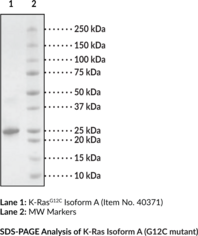
K-Ras is a small GTPase and member of the RAS family of GTPases with roles in apoptosis, as well as cell proliferation, survival, and migration.1,2 K-Ras is composed of a guanine nucleotide binding domain containing an active site, an effector binding domain, and an isoform-specific C-terminal hypervariable region, which varies by four amino acids between isoforms A and B.1,3 The active site cycles between GDP-bound inactive and GTP-bound active states and is regulated by its associations with GTPase-activating proteins (GAPs) or guanine nucleotide exchange factors (GEFs).3,4 K-Ras is ubiquitously expressed and is tethered to the intracellular side of cell membranes via farnesyl and palmitoyl lipidation.1,5 The glycine-to-cysteine substitution at position 12 mutant K-Ras (K-RasG12C) is constitutively active and found in pancreatic, colon, and lung cancers.6,2 Inhibition of K-RasG12C with a cysteine-targeted inhibitor ARS1620 (Item No. 27915) reduces tumor volume in K-RasG12C-expressing, but not K-RasG12V-expressing, MiaPaCa-2 pancreatic cancer mouse xenograft models.7 Tumor levels of K-RasG12C are increased in patients with lung adenocarcinoma who reported to be former or current smokers.8 Cayman's K-Ras Isoform A (G12C mutant; human, recombinant) consists of 185 amino acids and has a calculated molecular weight of 23 kDa. By SDS-PAGE, the apparent molecular mass of the protein is 25-26 kDa due to glycosylation.
WARNING This product is not for human or veterinary use.
References & Product Citations
1. A new view of Ras isoforms in cancers. Cancer Res. 76(1), 18-23 (2016).
2. Mutant K-
3. Discovery of potent SOS1 inhibitors that block RAS activation via disruption of the RAS-
4. Mechanism of inhibition by arachidonic acid of the catalytic activity of ras GTPase-
5. Oligomycins as inhibitors of K-
6. The KRASG12C inhibitor MRTX849 provides insight toward therapeutic susceptibility of KRAS-
7. Targeting KRAS mutant cancer cells with a covalent G12C-
8. Molecular epidemiology of EGFR and KRAS mutations in 3,026 lung adenocarcinomas: Higher susceptibility of women to smoking-
Contact Info
Cayman Chemical1180 East Ellsworth RoadAnn Arbor, Michigan 48108 USAToll Free: (800) 364-9897(USA and Canada only)Fax: (734) 971-3640


