
Technical Support & Resources
Visit our FAQ
Contact Us
Toll Free Phone (USA and Canada Only): (888) 526-5351
Direct Phone: (734) 975-3888
Product Categories
Product Type
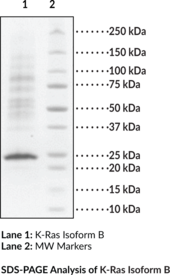
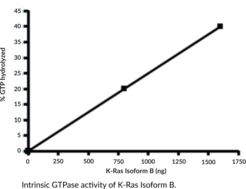
Technical Information
- c-K-ras(G12V)
- c-Ki-ras(G12V)
- K-Ras(G12V)
- K-Ras4A(G12V)
- Ki-Ras(G12V)
- Kirsten Rat Sarcoma Virus(G12V)
Shipping & Storage Information
Recommended Products
Certificates of Analysis & Batch Specific Data
Provide batch numbers separated by commas to download or request available product inserts, QC sheets, certificates of analysis, data packs, and GC-MS data.

Visit Our Cancer Resource Center
Find Tools & Resources to Study the Hallmarks of Cancer
- Cancer cell signaling & regulation
- Cancer metabolism
- Tumor microenvironment
Product Description
K-Ras is a small GTPase and member of the RAS family of GTPases with roles in apoptosis, as well as cell proliferation, survival, and migration.1,2 K-Ras is composed of a guanine nucleotide-binding domain containing an active site, an effector binding domain, and an isoform-specific C-terminal hypervariable region (HVR) that differs between K-Ras isoforms A and B due to alternative splicing.1,3,4 The active site cycles between GDP-bound inactive and GTP-bound active states and is regulated by its associations with GTPase-activating proteins (GAPs) or guanine nucleotide exchange factors (GEFs).3,5 K-Ras isoform B is ubiquitously expressed and is tethered to the intracellular side of cell membranes via farnesyl lipidation and to negatively charged regions of the membrane via two positively charged polybasic regions in the HVR.1,6,4 K-RasG12V, which contains a glycine-to-valine substitution at position 12, is constitutively active and associated with pancreatic, colon, and lung cancers.7 Tumor levels of K-RasG12V are negatively correlated with overall survival in patients with colorectal cancer.8 Cayman's K-Ras Isoform B (G12V mutant; human, recombinant) protein consists of 184 amino acids, has a calculated molecular weight of 22 kDa, and can be used for enzyme activity assay, inhibitor screening, and inhibitor selectivity profiling applications.
WARNING This product is not for human or veterinary use.
References & Product Citations
1. A new view of Ras isoforms in cancers. Cancer Res. 76(1), 18-23 (2016).
2. Mutant K-
3. Discovery of potent SOS1 inhibitors that block RAS activation via disruption of the RAS-
4. The K-
5. Mechanism of inhibition by arachidonic acid of the catalytic activity of ras GTPase-
6. Oligomycins as inhibitors of K-
7. A comprehensive survey of Ras mutations in cancer. Cancer Res. 72(10), 2457-2467 (2012).
8. Different types of K-
Contact Info
Cayman Chemical1180 East Ellsworth RoadAnn Arbor, Michigan 48108 USAToll Free: (800) 364-9897(USA and Canada only)Fax: (734) 971-3640


