
Technical Support & Resources
Visit our FAQ
Contact Us
Toll Free Phone (USA and Canada Only): (888) 526-5351
Direct Phone: (734) 975-3888
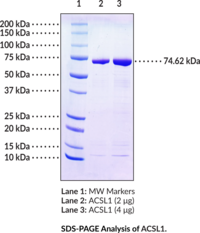
ACSL1 (human, recombinant; aa 48-698)
Item No. 40418
Technical Information
- Acyl-CoA Synthetase Long-chain Family Member 1
- FACL1
- Fatty Acid CoA Ligase 1
- LACS1
- Long-chain Fatty Acid-CoA Ligase 1
- Palmitoyl-CoA Ligase 1
Shipping & Storage Information
Recommended Products
Certificates of Analysis & Batch Specific Data
Provide batch numbers separated by commas to download or request available product inserts, QC sheets, certificates of analysis, data packs, and GC-MS data.
Lipid Resource Center
Discover Products & Resources for Lipid Research
- High-purity lipid standards
- Lipid roles in biology
- Lipids in health & disease
- Lipids for pharmaceutical development
- Protocols, advice, & resources
Product Description
Acyl-CoA synthetase long-chain family member 1 (ACSL1) is a long-chain acyl-CoA synthase that converts both saturated and unsaturated fatty acids into fatty acyl-CoA esters.1,2,3 It is expressed in liver, heart, adipose tissue, and muscle and, in the presence of TANK-binding kinase 1 (TBK1), localizes to the mitochondria where it promotes fatty acid β-oxidation.4,5 In the absence of TBK1, ACSL1 is localized to the endoplasmic reticulum (ER) and facilitates lipid accumulation.4 ACSL1 has broad substrate specificity for 16- and 18-carbon saturated fatty acids and 16-20-carbon unsaturated fatty acids.5 ACSL1 knockdown suppresses palmitate-induced increases in the inflammatory markers TNF-α, IL-1β, and CD11c and inhibits lipid accumulation and the transition into foam cells in THP-1 macrophages, as well as inhibits ferroptosis induced by α-eleostearic acid (9(Z),11(E),13(E)-octadecatrienoic acid (Item No. 10008349) in BT-549 cells.6,7 Levels of ACSL1 are increased in liver, breast, ovarian, and colorectal cancers compared with non-cancerous tissues.1 Cayman’s ACSL1 (human, recombinant; aa 48-698) protein can be used for ELISA, enzyme activity, and Western blot (WB) applications.
WARNING This product is not for human or veterinary use.
References & Product Citations
1. ACSL family: The regulatory mechanisms and therapeutic implications in cancer. Eur. J. Pharmacol. 909, 174397 (2021).
2. Mitochondrial reactive oxygen species in lipotoxic hearts induce post-
3. Defective fatty acid oxidation in mice with muscle-
4. TANK-
5. Identification of a novel function of hepatic long-
6. ACSL1 is a key regulator of inflammatory and macrophage foaming induced by short-
7. Ferroptotic cell death triggered by conjugated linolenic acids is mediated by ACSL1. Nat. Commun. 12(1), 2244 (2021).
Contact Info
Cayman Chemical1180 East Ellsworth RoadAnn Arbor, Michigan 48108 USAToll Free: (800) 364-9897(USA and Canada only)Fax: (734) 971-3640


