
Technical Support & Resources
Visit our FAQ
Contact Us
Toll Free Phone (USA and Canada Only): (888) 526-5351
Direct Phone: (734) 975-3888
Technical Information
- Acid Sphingomyelinase-like Phosphodiesterase 3A
- ASML3A
- ASM-like Phosphodiesterase 3A
- Sphingomyelin Phosphodiesterase Acid-like 3A
Shipping & Storage Information
Recommended Products
Certificates of Analysis & Batch Specific Data
Provide batch numbers separated by commas to download or request available product inserts, QC sheets, certificates of analysis, data packs, and GC-MS data.

Visit Our Cancer Resource Center
Find Tools & Resources to Study the Hallmarks of Cancer
- Cancer cell signaling & regulation
- Cancer metabolism
- Tumor microenvironment
Product Description
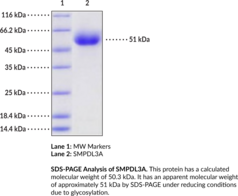
Sphingomyelin phosphodiesterase acid-like 3A (SMPDL3A) is a zinc-dependent nucleotide phosphoesterase and member of the acid sphingomyelinase-like enzyme family.1 It is composed of an N-terminal catalytic domain and a C-terminal domain, which contains an asparagine located at position 356 (Asn356). The N-glycosylation of Asn356 is required for SMPDL3A stability, enzymatic activity, and cellular secretion.1,2 SMPDL3A is expressed in, and secreted from, osteoclasts, adipocytes, astrocytes, and macrophages and reduces local inflammation induced by nucleotide tri- or diphosphates.3,1 Its intracellular levels and secretion are increased by cAMP, cholesterol, and liver X receptor (LXR) activation, and it localizes to the lysosome, which provides the acidic environment required for its optimal catalytic activity.3,1 SMPDL3A knockout decreases cell proliferation, colony formation, and migration, as well as induces cell cycle arrest in the G0/G1 phase and apoptosis in HepG2 hepatocellular carcinoma cells.4 In vivo, SMPDL3A knockout in HepG2 cells reduces tumor volume and weight in a HepG2 xenograft mouse model. SMPDL3A levels are increased in patients with hepatocellular carcinoma (HCC) and negatively correlated with prognosis. Cayman's SMPDL3A (human, recombinant; His-tagged) protein consists of 442 amino acids and has a calculated molecular weight of 50.3 kDa. By SDS-PAGE, under reducing conditions, the apparent molecular mass of the protein is 51 kDa due to glycosylation.
WARNING This product is not for human or veterinary use.
References & Product Citations
1. Structural basis for nucleotide hydrolysis by the acid sphingomyelinase-
2. N-
3. Sphingomyelin phosphodiesterase acid-
4. Sphingomyelin phodiesterase acid-
Contact Info
Cayman Chemical1180 East Ellsworth RoadAnn Arbor, Michigan 48108 USAToll Free: (800) 364-9897(USA and Canada only)Fax: (734) 971-3640


