
Technical Support & Resources
Visit our FAQ
Contact Us
Toll Free Phone (USA and Canada Only): (888) 526-5351
Direct Phone: (734) 975-3888
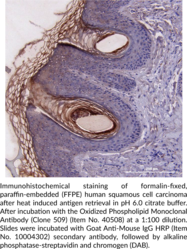
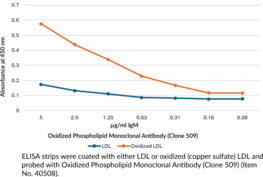
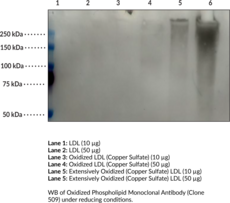
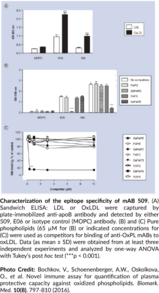
Technical Information
- OxPL
Shipping & Storage Information
Recommended Products
Certificates of Analysis & Batch Specific Data
Provide batch numbers separated by commas to download or request available product inserts, QC sheets, certificates of analysis, data packs, and GC-MS data.
Lipid Resource Center
Discover Products & Resources for Lipid Research
- High-purity lipid standards
- Lipid roles in biology
- Lipids in health & disease
- Lipids for pharmaceutical development
- Protocols, advice, & resources
Product Description
Oxidized phospholipids (OxPLs) are a class of lipid mediators involved in diverse physiological and pathological processes.1 In particular, fragmented OxPLs on the surface of LDL can be formed via β-scission of the sn-2 fatty acid fragment on the glycerol backbone and are immunogenic.1,2 The 509 OxPL antibody clone binds to oxidized LDL (OxLDL) and selectively binds to oxidized 1-palmitoyl-2-arachidonoyl-sn-glycero-3-phosphoethanolamine (OxPAPE) over PAPE, oxidized 1-palmitoyl-2-arachidonoyl-sn-glycero-3-phosphocholine (OxPAPC), PAPC, oxidized 1-palmitoyl-2-arachidonoyl-sn-glycero-3-phosphoserine (OxPAPS), PAPS, oxidized 1-palmitoyl-2-arachidonoyl-sn-glycero-3-phosphatidic acid (OxPAPA), and PAPA.3 Cayman’s Oxidized Phospholipid Monoclonal Antibody (Clone 509) can be used for ELISA, immunohistochemistry (IHC), and Western blot (WB) applications. The original 509 antibody was generated via immunization of mice with OxPAPC and oxLDL with Freund’s adjuvant.3
WARNING This product is not for human or veterinary use.
References & Product Citations
1. Pleiotropic effects of oxidized phospholipids. Free Radic. Biol. Med. 111, 6-24 (2017).
2. Antiphospholipid antibodies are directed against epitopes of oxidized phospholipids. Recognition of cardiolipin by monoclonal antibodies to epitopes of oxidized low density lipoprotein. J. Clin. Invest. 98(3), 815-825 (1996).
3. Novel immune assay for quantification of plasma protective capacity against oxidized phospholipids. Biomark. Med. 10(8), 797-810 (2016).
Contact Info
Cayman Chemical1180 East Ellsworth RoadAnn Arbor, Michigan 48108 USAToll Free: (800) 364-9897(USA and Canada only)Fax: (734) 971-3640


