
Technical Support & Resources
Visit our FAQ
Contact Us
Toll Free Phone (USA and Canada Only): (888) 526-5351
Direct Phone: (734) 975-3888
Technical Information
- CCK-4
- Colon Carcinoma Kinase 4
- Inactive Tyrosine-protein Kinase 7
- Protein-tyrosine Kinase 7
- Pseudo Tyrosine Kinase Receptor 7
- Tyrosine-protein Kinase-like 7
Shipping & Storage Information
Recommended Products
Certificates of Analysis & Batch Specific Data
Provide batch numbers separated by commas to download or request available product inserts, QC sheets, certificates of analysis, data packs, and GC-MS data.

Visit Our Cancer Resource Center
Find Tools & Resources to Study the Hallmarks of Cancer
- Cancer cell signaling & regulation
- Cancer metabolism
- Tumor microenvironment
Product Description
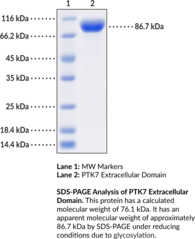
Inactive tyrosine-protein kinase 7 (PTK7) is a transmembrane receptor involved in morphogenesis.1 It is composed of a signal peptide, seven immunoglobulin-like (Ig-like) domains, a transmembrane domain, a juxtamembrane domain, and a catalytically inactive tyrosine kinase domain.2 PTK7 is expressed in pancreas, kidney, liver, lung, and placenta, as well as brain, heart, and melanocytes, and localizes to cell-cell junctions.3,4 It also undergoes alternative splicing to generate isoforms that exhibit tissue-specific distributions.2 Soluble PTK7 is produced by proteolytic cleavage of the extracellular domain by matrix metalloproteinase-14 (MMP-14), also known as membrane type-1 MMP (MT1-MMP).4 PTK7 plays a role in planar cell polarity, gastrulation, neural tube closure, neural crest migration, cardiac morphogenesis, and epidermal wound repair and participates in canonical and non-canonical Wnt signaling.1 Ectopic expression of PTK7 without the kinase domain induces migration of murine hematopoietic cells expressing the human protein and recombinant human soluble PTK7 inhibits VEGF-induced capillary tube formation in human umbilical vein endothelial cells (HUVECs).5,6 A PTK7-targeting antibody-drug conjugate containing the DNA topoisomerase I inhibitor exatecan (Item No. 35452) induces tumor regression in a breast cancer mouse xenograft model.7 Overexpression of PTK7 is associated with poor prognosis in patients with acute myeloid leukemia (AML).5 Cayman’s PTK7 Extracellular Domain (human, recombinant) protein consists of 685 amino acids, has a calculated molecular weight of 76.1 kDa, and a predicted N-terminus of Ala31 after signal peptide cleavage. By SDS-PAGE, under reducing conditions, the apparent molecular mass of the protein is 86.7 kDa due to glycosylation.
WARNING This product is not for human or veterinary use.
References & Product Citations
1. The many roles of PTK7: A versatile regulator of cell-
2. Organization of the human PTK7 gene encoding a receptor protein tyrosine kinase-
3. Characterization of the human full-
4. The Wnt/planar cell polarity protein-
5. The cell polarity PTK7 receptor acts as a modulator of the chemotherapeutic response in acute myeloid leukemia and impairs clinical outcome. 116(13), 2315-2323 (2010).
6. Soluble PTK7 inhibits tube formation, migration, and invasion of endothelial cells and angiogenesis. Biochem. Biophys. Res. Commun. 371(4), 793-798 (2008).
7. MTX-
Contact Info
Cayman Chemical1180 East Ellsworth RoadAnn Arbor, Michigan 48108 USAToll Free: (800) 364-9897(USA and Canada only)Fax: (734) 971-3640


