
Technical Support & Resources
Visit our FAQ
Contact Us
Toll Free Phone (USA and Canada Only): (888) 526-5351
Direct Phone: (734) 975-3888
Product Categories
Product Type
Technical Information
- Double-strand Break Repair MRE11
- Meiotic Recombination 11
Shipping & Storage Information
Recommended Products
Certificates of Analysis & Batch Specific Data
Provide batch numbers separated by commas to download or request available product inserts, QC sheets, certificates of analysis, data packs, and GC-MS data.

Visit Our Cancer Resource Center
Find Tools & Resources to Study the Hallmarks of Cancer
- Cancer cell signaling & regulation
- Cancer metabolism
- Tumor microenvironment
Product Description
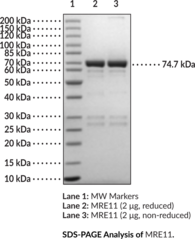
Meiotic recombination 11 homolog (MRE11) is an endo- and exonuclease and member of the MRE11-RAD50-NBS1 (MRN) complex, which is involved in DNA double-strand break repair.1 It exists as a homodimer and is composed of an N-terminal nuclease domain with five phosphodiesterase motifs, two dimerization motifs, and a Nijmegen breakage syndrome protein 1 (NBS1) interaction domain, a capping domain, and a C-terminal domain that contains two DNA-binding domains on either side of the RAD50 interaction domain.2 Alternative splicing of MRE11 produces two main isoforms, MRE11 isoform 1, which is the full-length isoform, and MRE11 isoform 2, which lacks exon 16.3 MRE11 is expressed in proliferative tissues such as testis and spleen and localizes to the nucleus following DNA damage.4,5 It is involved in homologous recombination (HR) and non-homologous end joining (NHEJ) and forms complexes with two dsDNA ends (synaptic complex) or a single ssDNA or dsDNA end (branched complex).2 Knockdown of MRE11 sensitizes cells to radiation in vitro, an effect that can be rescued by expression of MRE11 isoform 1 or 2.3 Overexpression of MRE11 increases tumor volume in a breast cancer mouse xenograft model.6 Mutations in MRE11 are associated with ataxia-telangiectasia-like disorder (ATLD) and cancer.5,7 Cayman’s MRE11 (human, recombinant; aa 1-411) protein has a calculated molecular weight of 74.7 kDa.
WARNING This product is not for human or veterinary use.
References & Product Citations
1. DNA double-
2. MRN and the race to the break. Chromosoma 119(2), 115-135 (2010).
3. MRE11A isoform expression associated with outcome following radiotherapy in muscle-
4. Isolation and characterization of the human MRE11 homologue. Genomics 29(1), 80-86 (1995).
5. The DNA double-
6. Role of MRE11 in cell proliferation, tumor invasion, and DNA repair in breast cancer. J. Natl. Cancer Inst. 104(19), 1485-1502 (2012).
7. Alterations of the double-
Contact Info
Cayman Chemical1180 East Ellsworth RoadAnn Arbor, Michigan 48108 USAToll Free: (800) 364-9897(USA and Canada only)Fax: (734) 971-3640


