
Technical Support & Resources
Visit our FAQ
Contact Us
Toll Free Phone (USA and Canada Only): (888) 526-5351
Direct Phone: (734) 975-3888
Technical Information
- TL1
- TL1A
- sTL1A
- TNF Ligand-related Molecule 1
- Tumor Necrosis Factor Ligand Superfamily Member 15
- Vascular Endothelial Cell Growth Inhibitor
- VEGI
- VEGI192A
Shipping & Storage Information
Certificates of Analysis & Batch Specific Data
Provide batch numbers separated by commas to download or request available product inserts, QC sheets, certificates of analysis, data packs, and GC-MS data.

Visit Our Cancer Resource Center
Find Tools & Resources to Study the Hallmarks of Cancer
- Cancer cell signaling & regulation
- Cancer metabolism
- Tumor microenvironment
Product Description
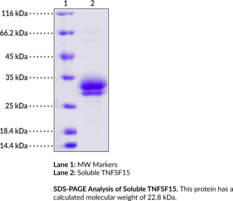
Tumor necrosis factor ligand superfamily member 15 (TNFSF15), also known as TNF ligand-related molecule 1 (TL1A), is a type II transmembrane protein and cognate ligand for TNFRSF25, also known as death domain receptor 3 (DR3), with roles in T cell activation and dendritic cell maturation.1,2 It is composed of a cytoplasmic, a transmembrane, and an extracellular domain and forms membrane-bound non-covalent homotrimers. TNFSF15 exists primarily in its membrane-bound form, but can be cleaved by matrix metalloproteinases (MMPs) to release the soluble form (sTL1A).1,3 Both membrane-bound and soluble TNFSF15 bind to TNFRSF25 on the surface of T cells, inducing various signaling pathways resulting in NF-κB activation or apoptosis.3 TNFSF15 also binds to TNF receptor 2 (TNFR2) and TNFR6B, also known as soluble decoy receptor 3 (DcR3), on the surface of T cells to induce pro-inflammatory cytokine production and the inhibition of apoptosis. Intestinal levels of TNFSF15 are increased in patients with inflammatory bowel disease (IBD).4 TNFSF15 SNPs are associated with an increased susceptibility to developing small cell lung cancer (SCLC).5 Cayman’s Soluble TNFSF15 (human, recombinant) protein consists of 199 amino acids and has a calculated molecular weight of 22.8 kDa.
WARNING This product is not for human or veterinary use.
References & Product Citations
1. TL1A (TNFSF15) and DR3 (TNFRSF25): A co-
2. Role of TNFSF15 variants in oral cancer development and clinicopathologic characteristics. J. Cell. Mol. Med. 26(21), 5452-5462 (2022).
3. Role of TL1A in inflammatory autoimmune diseases: A comprehensive review. Front. Immunol. 13:891328, (2022).
4. TNFSF15 promotes antimicrobial pathways in human macrophages and these are modulated by TNFSF15 disease-
5. TNFSF15 promoter polymorphisms increase the susceptibility to small cell lung cancer: A case-
Contact Info
Cayman Chemical1180 East Ellsworth RoadAnn Arbor, Michigan 48108 USAToll Free: (800) 364-9897(USA and Canada only)Fax: (734) 971-3640


