
Technical Support & Resources
Visit our FAQ
Contact Us
Toll Free Phone (USA and Canada Only): (888) 526-5351
Direct Phone: (734) 975-3888
Product Categories
Product Type
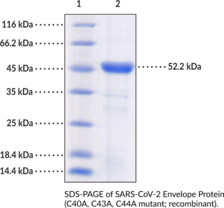
SARS-CoV-2 Envelope Protein (C40A, C43A, C44A mutant; recombinant)
Item No. 40875
Technical Information
- SARS-CoV-2 E Protein
- SARS-CoV-2 Envelope Small Membrane Protein
- SARS-CoV-2 sM Protein
- Severe Acute Respiratory Syndrome Coronavirus 2 Envelope Protein
Shipping & Storage Information
Recommended Products
Certificates of Analysis & Batch Specific Data
Provide batch numbers separated by commas to download or request available product inserts, QC sheets, certificates of analysis, data packs, and GC-MS data.
Neutrophil Biology Wall Poster
Explore how neutrophils shape the immune response in health and disease. This poster highlights neutrophil pathogen defense mechanisms, including phagocytosis, degranulation, and NETosis, as well as neutrophil roles in inflammation and NET-associated pathologies.
DOWNLOAD NOWProduct Description
Severe acute respiratory syndrome coronavirus 2 (SARS-CoV-2) is an enveloped positive-stranded RNA virus, a member of the Betacoronavirus genus, and the causative agent of COVID-19.1,2,3 The SARS-CoV-2 genome contains approximately 30 kilobases and 14 open reading frames (ORFs) that encode four structural proteins: spike, envelope, membrane, and nucleocapsid, as well as 16 non-structural proteins and nine accessory factors.4 The SARS-CoV-2 envelope protein (E protein) is composed of an N-terminal domain, a transmembrane domain, and a C-terminal domain, which contains three conserved cysteine residues (C40, C43, and C44) that are post-translationally palmitoylated in a similar virus, SARS-CoV.5,6 It localizes to the Golgi, endoplasmic reticulum (ER), and ER-Golgi intermedium compartment (ERGIC) of SARS-CoV-2 infected cells and homo-oligomerization of the E protein forms a pH-sensitive, cation-selective ion channel, also known as a viroporin.7,5 It is involved in morphogenesis, viral assembly, and maturation and retention of the spike glycoprotein, also known as surface glycoprotein.5,8 SARS-CoV-2 E protein is acetylated by the histone acetyltransferase p300, and acetylated SARS-CoV-2 E protein binds to bromodomain-containing protein 4 (BRD4).9 Intravenous administration of recombinant SARS-CoV-2 E protein induces spleen edema, as well as pulmonary inflammatory cell infiltration, edema, interstitial hyperemia, hemorrhage, and alveolar collapse in mice.10 Cayman’s SARS-CoV-2 Envelope Protein (C40A, C43A, C44A mutant; recombinant) protein consists of 475 amino acids and has a calculated molecular weight of 52.2 kDa.
WARNING This product is not for human or veterinary use.
References & Product Citations
1. From SARS and MERS CoVs to SARS-
2. Genomic characterisation and epidemiology of 2019 novel coronavirus: Implications for virus origins and receptor binding. Lancet 395(10224), 565-574 (2020).
3. Novel coronavirus 2019-
4. A structural view of SARS-
5. The envelope (E) protein of SARS-
6. Biochemical and functional characterization of the membrane association and membrane permeabilizing activity of the severe acute respiratory syndrome coronavirus envelope protein. Virology 349(2), 264-275 (2006).
7. The envelope protein of SARS-
8. The SARS-
9. Binding of the SARS-
10. SARS-
Contact Info
Cayman Chemical1180 East Ellsworth RoadAnn Arbor, Michigan 48108 USAToll Free: (800) 364-9897(USA and Canada only)Fax: (734) 971-3640


