
Technical Support & Resources
Visit our FAQ
Contact Us
Toll Free Phone (USA and Canada Only): (888) 526-5351
Direct Phone: (734) 975-3888
Product Categories
Product Type
MERS-CoV Nucleocapsid Protein (recombinant)
Item No. 40878
Technical Information
- MERS-CoV Nucleoprotein
- MERS-CoV N Protein
Shipping & Storage Information
Recommended Products
Certificates of Analysis & Batch Specific Data
Provide batch numbers separated by commas to download or request available product inserts, QC sheets, certificates of analysis, data packs, and GC-MS data.
Neutrophil Biology Wall Poster
Explore how neutrophils shape the immune response in health and disease. This poster highlights neutrophil pathogen defense mechanisms, including phagocytosis, degranulation, and NETosis, as well as neutrophil roles in inflammation and NET-associated pathologies.
DOWNLOAD NOWProduct Description
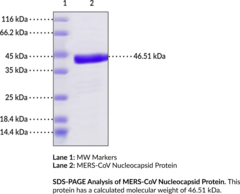
Middle East respiratory syndrome coronavirus (MERS-CoV) is an enveloped positive-stranded RNA virus, a member of the Betacoronavirus genus, and a causative agent of MERS, an acute respiratory disease that often leads to pneumonia and renal failure.1,2 The MERS-CoV nucleocapsid protein is composed of an intrinsically disordered region (IDR), an N-terminal domain that binds RNA, a flexible linker containing serine and arginine phosphorylation sites, a C-terminal domain that also participates in RNA binding and is responsible for dimerization, and another IDR.3,4 Coronavirus nucleocapsid proteins, including the MERS-CoV nucleocapsid protein, package the viral genome into a ribonucleoprotein (RNP) complex.4 In addition, the MERS-CoV nucleocapsid protein interacts with the ubiquitin ligase TRIM25 and inhibits the activation of retinoic acid-inducible gene I (RIG-I) and phosphorylation of IFN regulatory factor 3 (IRF3) and NF-κB.5 It reduces IFN-β and IFN-λ1 promoter activity induced by the RIG-I caspase activation and recruitment domain (RIG-I-CARD), but not MDA5-CARD, and reduces Sendai virus-induced increases in IFN-β and IFN-λ1 mRNA levels. Cayman's MERS-CoV Nucleocapsid Protein (recombinant) consists of 424 amino acids and has a calculated molecular weight of 46.51 kDa.
WARNING This product is not for human or veterinary use.
References & Product Citations
1. MERS-
2. SARS-
3. Structural characterization of the N-
4. Comparing the nucleocapsid proteins of human coronaviruses: Structure, immunoregulation, vaccine, and targeted drug. Front. Mol. Biosci. 9, 761173 (2022).
5. Middle East respiratory syndrome coronavirus nucleocapsid protein suppresses type I and type III interferon induction by targeting RIG-
Contact Info
Cayman Chemical1180 East Ellsworth RoadAnn Arbor, Michigan 48108 USAToll Free: (800) 364-9897(USA and Canada only)Fax: (734) 971-3640


