
Technical Support & Resources
Visit our FAQ
Contact Us
Toll Free Phone (USA and Canada Only): (888) 526-5351
Direct Phone: (734) 975-3888
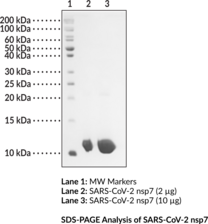
Technical Information
- SARS-CoV-2 Non-structural Protein 7
- Severe Acute Respiratory Syndrome Coronavirus 2 nsp7
Shipping & Storage Information
Recommended Products
Certificates of Analysis & Batch Specific Data
Provide batch numbers separated by commas to download or request available product inserts, QC sheets, certificates of analysis, data packs, and GC-MS data.
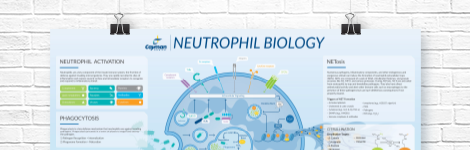
Neutrophil Biology Wall Poster
Explore how neutrophils shape the immune response in health and disease. This poster highlights neutrophil pathogen defense mechanisms, including phagocytosis, degranulation, and NETosis, as well as neutrophil roles in inflammation and NET-associated pathologies.
DOWNLOAD NOWProduct Description
Severe acute respiratory syndrome coronavirus 2 (SARS-CoV-2) is an enveloped positive-stranded RNA virus and the causative agent of COVID-19, a primarily respiratory illness characterized by fever, cough, and shortness of breath that can lead to life-threatening complications.1,2,3,4,5 The SARS-CoV-2 genome contains approximately 30 kilobases and 14 open reading frames (ORFs) that encode four structural proteins: spike, envelope, membrane, and nucleocapsid, as well as 16 non-structural proteins and 9 accessory factors.6 SARS-CoV-2 non-structural protein 7 (nsp7) is encoded within ORF1ab and is a cofactor in the RNA replication transcriptional complex. nsp7 is highly conserved in coronaviruses, and in SARS-CoV-2 it forms a decameric RNA replication transcriptional complex with the RNA polymerase cofactor nsp8 and the RNA-dependent RNA polymerase (RdRp) nsp12.7 Mutations in the nsp7-nps8 binding interface reduce the stability of the RNA replication transcriptional complex, leading to impaired RNA polymerase activity.8
WARNING This product is not for human or veterinary use.
References & Product Citations
1. From SARS and MERS CoVs to SARS-
2. Genomic characterisation and epidemiology of 2019 novel coronavirus: Implications for virus origins and receptor binding. Lancet 395(10224), 565-574 (2020).
3. Novel coronavirus 2019-
4. Incidence of thrombotic complications in critically ill ICU patients with COVID-
5. Analysis of 92 deceased patients with COVID-
6. A structural view of SARS-
7. Structural basis for RNA replication by the SARS-
8. Two conserved oligomer interfaces of NSP7 and NSP8 underpin the dynamic assembly of SARS-
Contact Info
Cayman Chemical1180 East Ellsworth RoadAnn Arbor, Michigan 48108 USAToll Free: (800) 364-9897(USA and Canada only)Fax: (734) 971-3640


