
Technical Support & Resources
Visit our FAQ
Contact Us
Toll Free Phone (USA and Canada Only): (888) 526-5351
Direct Phone: (734) 975-3888
Product Categories
Product Type
Ebola Virus Nucleoprotein (subtype Sudan, strain Gulu) (recombinant; aa 630-738)
Item No. 41064
Technical Information
Shipping & Storage Information
Recommended Products
Certificates of Analysis & Batch Specific Data
Provide batch numbers separated by commas to download or request available product inserts, QC sheets, certificates of analysis, data packs, and GC-MS data.
Neutrophil Biology Wall Poster
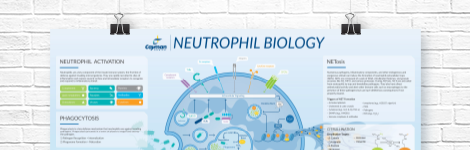
Explore how neutrophils shape the immune response in health and disease. This poster highlights neutrophil pathogen defense mechanisms, including phagocytosis, degranulation, and NETosis, as well as neutrophil roles in inflammation and NET-associated pathologies.
DOWNLOAD NOWProduct Description
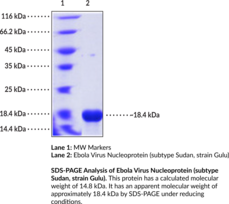
Ebola virus (EBOV) is an enveloped and negative-stranded RNA virus, a member of the Ebolavirus genus, and the causative agent of Ebola virus disease (EVD), a condition characterized by a hemorrhagic fever and a high mortality rate, that is endemic to western and equatorial Africa.1 The single-stranded RNA genome of EBOV encodes seven proteins: nucleoprotein (NP), virion protein 40 (VP40), VP35, VP30, VP24, glycoprotein (GP), and an RNA-dependent RNA polymerase (L).1,2 Ebola virus NP is a 739-amino acid protein composed of an N-terminal domain, which is required for protein oligomerization and RNA binding, linked by an unstructured region to a C-terminal domain that functions as a protein-protein interaction hub and forms the viral nucleocapsid that encapsulates the RNA genome throughout the virus life cycle.3,4 This NP nucleocapsid is a protein-RNA complex acts as a scaffold for additional viral proteins, including L, the viral polymerase, to complete viral replication.4 Additionally, the Ebola virus NP is essential to viral genome replication, transcription, and maintenance of viral structure and protects the viral genome from host nucleases.3 Cayman's Ebola Virus Nucleoprotein (subtype Sudan, Strain Gulu) (recombinant; aa 630-738) consists of 108 amino acids and has a calculated molecular weight of 14.8 kDa. By SDS-PAGE, under reducing conditions, the apparent molecular mass of the protein is ~18.4 kDa.
WARNING This product is not for human or veterinary use.
References & Product Citations
1. Ebola virus disease: An emerging and re-
2. Ebola virus entry: From molecular characterization to drug discovery. Viruses 11(3), 274 (2019).
3. Fragment screening targeting Ebola virus nucleoprotein C-
4. Cryo-
Contact Info
Cayman Chemical1180 East Ellsworth RoadAnn Arbor, Michigan 48108 USAToll Free: (800) 364-9897(USA and Canada only)Fax: (734) 971-3640


