
Technical Support & Resources
Visit our FAQ
Contact Us
Toll Free Phone (USA and Canada Only): (888) 526-5351
Direct Phone: (734) 975-3888
Product Categories
Product Type
Ebola Virus Envelope Glycoprotein GP1 Subunit (subtype Bundibugyo, strain Uganda 2007) (recombinant)
Item No. 41066
Technical Information
- EBOV Envelope Glycoprotein GP1 Subunit
- EBOV-GP1
Shipping & Storage Information
Recommended Products
Certificates of Analysis & Batch Specific Data
Provide batch numbers separated by commas to download or request available product inserts, QC sheets, certificates of analysis, data packs, and GC-MS data.
Neutrophil Biology Wall Poster
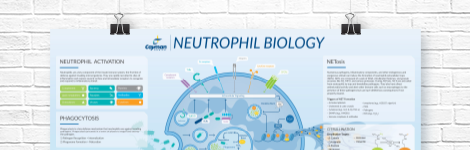
Explore how neutrophils shape the immune response in health and disease. This poster highlights neutrophil pathogen defense mechanisms, including phagocytosis, degranulation, and NETosis, as well as neutrophil roles in inflammation and NET-associated pathologies.
DOWNLOAD NOWProduct Description
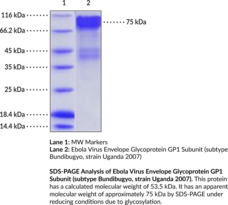
Ebola virus (EBOV) is an enveloped and negative-stranded RNA virus, a member of the Ebolavirus genus, and the causative agent of Ebola virus disease (EVD), a condition characterized by a hemorrhagic fever and a high mortality rate, that is endemic to western and equatorial Africa.1 The single-stranded RNA genome of EBOV encodes seven proteins: nucleoprotein (NP), virion protein 40 (VP40), VP35, VP30, VP24, glycoprotein (GP), and an RNA-dependent RNA polymerase (L).1,2 EBOV envelope GP is a class I fusion protein involved in viral attachment and entry to host cells.3 It is composed of two subunits, GP1 and GP2, which are separated by a furin cleavage site and linked via disulfide bonds to form trimers of heterodimers with a chalice and cradle-like structure.4,3,5 EBOV GP is covered with N- and O-linked glycans, and the GP1 subunit is composed of a signal peptide, base, and head domains, a glycan cap, which shields the receptor-binding site, and a mucin-like domain, which is heavily glycosylated with O-linked glycans.4,3 The GP1 subunit is involved in host cell attachment, and cleavage of the glycan cap and mucin-like domain by host cathepsin B, with cathepsin L in an accessory role, is required for binding to the host cell.3,6 Once fused, the EBOV virion enters the cell via macropinocytosis and is transported to the endosome. The glycosylation of the glycan cap and dense glycosylation of the GP1 mucin-like domain shield surface epitopes and prevent neutralizing antibodies from interacting with regions required for host cell binding, fusion, and entry.7,5 Cayman's Ebola Virus Envelope Glycoprotein GP1 Subunit (subtype Bundibugyo, strain Uganda 2007) (recombinant) protein consists of 480 amino acids, has a calculated molecular weight of 53.5 kDa, and a predicted N-terminus of Ile33 after signal peptide cleavage. By SDS-PAGE, under reducing conditions (if applicable), the apparent molecular mass of the protein is approximately 75 kDa due to glycosylation.
WARNING This product is not for human or veterinary use.
References & Product Citations
1. Ebola virus disease: An emerging and re-
2. Ebola virus entry: From molecular characterization to drug discovery. Viruses 11(3), 274 (2019).
3. Biochemical and structural characterization of cathepsin L-
4. Structure of the Ebola virus glycoprotein bound to an antibody from a human survivor. Nature 454(7201), 177-182 (2008).
5. The secret life of viral entry glycoproteins: Moonlighting in immune evasion. PLoS Pathog. 9(5), e1003258 (2013).
6. Filovirus entry into cells -
7. N-
Contact Info
Cayman Chemical1180 East Ellsworth RoadAnn Arbor, Michigan 48108 USAToll Free: (800) 364-9897(USA and Canada only)Fax: (734) 971-3640


