
Technical Support & Resources
Visit our FAQ
Contact Us
Toll Free Phone (USA and Canada Only): (888) 526-5351
Direct Phone: (734) 975-3888
Product Categories
Product Type
Zika Virus Envelope Protein (strain Zika SPH2015) (T366A, Q367G, W391R, L397R mutant; recombinant)
Item No. 41068
Technical Information
- Zika Virus E Protein
- ZIKV E Protein
- ZIKV Envelope Protein
Shipping & Storage Information
Recommended Products
Certificates of Analysis & Batch Specific Data
Provide batch numbers separated by commas to download or request available product inserts, QC sheets, certificates of analysis, data packs, and GC-MS data.
Neutrophil Biology Wall Poster
Explore how neutrophils shape the immune response in health and disease. This poster highlights neutrophil pathogen defense mechanisms, including phagocytosis, degranulation, and NETosis, as well as neutrophil roles in inflammation and NET-associated pathologies.
DOWNLOAD NOWProduct Description
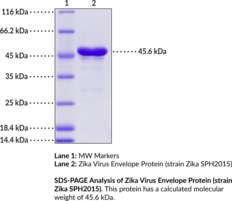
Zika virus (ZIKV) is a mosquito-borne, positive-stranded RNA virus and a member of the Flavivirus genus.1,2 ZIKV infection is associated with fever, rashes, and conjunctivitis, as well as more severe symptoms, which include Guillain-Barré syndrome in adults and microcephaly or congenital malformations in fetuses and newborns.1,3 The single-stranded RNA genome of ZIKV is translated as a polypeptide, which is cleaved by host and viral proteases into structural capsid (C), precursor membrane (prM), and envelope (E) proteins and seven non-structural proteins: NS1, NS2A, NS2B, NS3, NS4A, NS4B, and NS5.1,4 ZIKV E protein is composed of a structural domain, a dimerization domain, which contains a membrane fusion loop, and a structural domain containing a hinge region, two transmembrane helices, and a host receptor-binding region.2 It is a homodimer in the viral membrane but transitions to a homotrimer state in host cell organelles with low pH, in which viral replication and assembly occurs, as well as where E protein can form a heterodimer with prM.4 ZIKV E protein glycosylation at an N-terminal asparagine is necessary for ZIKV infectivity and optimal replication in cells and mice.3 Cayman's Zika Virus Envelope Protein (strain Zika SPH2015) (T366A, Q367G, W391R, L397R mutant; recombinant) protein consists of 405 amino acids, has a calculated molecular weight of 45.6 kDa, and a predicted N-terminus of Ile291 after signal peptide cleavage.
WARNING This product is not for human or veterinary use.
References & Product Citations
1. Crystal structure of Zika virus NS2B-
2. The key amino acids of E protein involved in early flavivirus infection: Viral entry. Virol. J. 18(1), 136 (2021).
3. Envelope protein glycosylation mediates Zika virus pathogenesis. J. Virol. 93(12), e00113-e00119 (2019).
4. Structures of the Zika virus envelope protein and its complex with a flavivirus broadly protective antibody. Cell Host Microbe. 19(5), 696-704 (2016).
Contact Info
Cayman Chemical1180 East Ellsworth RoadAnn Arbor, Michigan 48108 USAToll Free: (800) 364-9897(USA and Canada only)Fax: (734) 971-3640


