
Technical Support & Resources
Visit our FAQ
Contact Us
Toll Free Phone (USA and Canada Only): (888) 526-5351
Direct Phone: (734) 975-3888
Technical Information
- Nerve Injury-induced Protein 1
- NINJ1
Shipping & Storage Information
Recommended Products
Certificates of Analysis & Batch Specific Data
Provide batch numbers separated by commas to download or request available product inserts, QC sheets, certificates of analysis, data packs, and GC-MS data.

Visit Our Cancer Resource Center
Find Tools & Resources to Study the Hallmarks of Cancer
- Cancer cell signaling & regulation
- Cancer metabolism
- Tumor microenvironment
Product Description
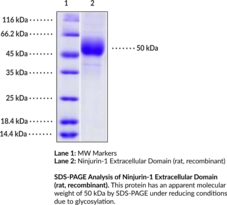
Ninjurin-1 is a type 3b transmembrane protein and adhesion molecule.1 It is composed of an N-terminal extracellular domain containing a region required for homophilic binding, two transmembrane domains, a short intracellular region, and a second extracellular domain at the C-terminal.1,2 The N-terminal extracellular domain can be cleaved by matrix metalloprotease-9 (MMP-9) to release soluble ninjurin-1 (sNinj1).3 Ninjurin-1 is expressed in Schwann cells, neurons, and certain activated immune cells, including macrophages and T cells, as well as embryonic and adult epithelial tissues.1,4 It is involved in cell adhesion, axonal growth, and chemotaxis, as well as cell lysis and damage-associated molecular pattern (DAMP) molecule release during pyroptosis, among other activities.2,4 NINJ1 knockout reduces disease severity in a mouse model of experimental autoimmune encephalomyelitis (EAE).5 The expression of Ninj1 is increased in Schwann cells and dorsal root ganglion neurons after nerve injury in rats, and ninjurin-1 is involved in peripheral nerve regeneration after sciatic nerve injury in mice.4,6 An A-C reversal in the third exon of NINJ1, which results in an aspartate-to-alanine mutation, increases the likelihood of developing nerve damage in patients with leprosy.4 Serum levels of sNinj1 are increased in patients with hepatocellular carcinoma and are positively correlated with tumor size, cancer stage, and metastasis.3 Cayman’s Ninjurin-1 Extracellular Domain (rat, recombinant) protein is a disulfide-linked homodimer. The reduced monomer, composed of ninjurin-1 (amino acids 1-79) fused to human IgG1 Fc at its N-terminus, consists of 340 amino acids and has a calculated molecular weight of 37 kDa. As a result of glycosylation, the monomer migrates at approximately 50 kDa by SDS-PAGE under reducing conditions.
WARNING This product is not for human or veterinary use.
References & Product Citations
1. Ninjurin, a novel adhesion molecule, is induced by nerve injury and promotes axonal growth. Neuron 17(2), 353-361 (1996).
2. Ninjurin1 enhances the basal motility and transendothelial migration of immune cells by inducing protrusive membrane dynamics. The Journal of Biological Chemisty 289(32), 21926-21936 (2014).
3. Circulating sNinj1 as a novel predictor of prognosis and severity in hepatocellular carcinoma. Clin. Chim. Acta 550, 117581 (2023).
4. The role of Ninjurin1 and its impact beyond the nervous system. Dev. Neurosci. 42(5-6), 159-169 (2020).
5. Ninjurin1 deficiency attenuates susceptibility of experimental autoimmune encephalomyelitis in mice. The Journal of Biological Chemisty 289(6), 3328-3338 (2014).
6. Ninjurin 1 mediates peripheral nerve regeneration through Schwann cell maturation of NG2-
Contact Info
Cayman Chemical1180 East Ellsworth RoadAnn Arbor, Michigan 48108 USAToll Free: (800) 364-9897(USA and Canada only)Fax: (734) 971-3640


