
Technical Support & Resources
Visit our FAQ
Contact Us
Toll Free Phone (USA and Canada Only): (888) 526-5351
Direct Phone: (734) 975-3888
Technical Information
- Phosphatidylcholine:ceramide Cholinephosphotransferase 2
- SMS2
Shipping & Storage Information
Recommended Products
Certificates of Analysis & Batch Specific Data
Provide batch numbers separated by commas to download or request available product inserts, QC sheets, certificates of analysis, data packs, and GC-MS data.
Lipid Resource Center
Discover Products & Resources for Lipid Research
- High-purity lipid standards
- Lipid roles in biology
- Lipids in health & disease
- Lipids for pharmaceutical development
- Protocols, advice, & resources
Product Description
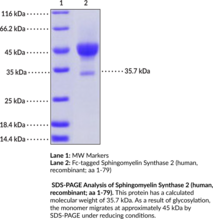
Sphingomyelin synthases (SMSs) are the final enzymes required for the de novo synthesis of sphingomyelin.1,2 There are three isoforms of sphingomyelin synthase: SMS1, SMS2, and SMSr, which are localized to the Golgi, Golgi and plasma membrane, and endoplasmic reticulum, respectively. All SMSs are composed of six transmembrane domains, with N- and C-terminal cytoplasmic tails. SMS2 also contains four C-terminal palmitoylation sites which are essential to its plasma membrane localization.1 It is a bifunctional enzyme responsible for the synthesis of both sphingomyelin and ceramide phosphoethanolamine, with sphingomyelin synthesis being its primary function.2 SMS2 catalyzes the transfer of a phosphocholine headgroup from phosphatidylcholine to ceramide in the Golgi to produce sphingomyelin. Knockdown of Sgms2, the gene encoding Sms2, decreases M2-like macrophage polarization in vitro and reduces tumor weight and lung metastasis in a 4T1 murine mammary carcinoma model.3 Sgms2 knockdown also inhibits steatosis but increases fibrosis in a mouse model of non-alcoholic steatohepatitis (NASH) induced by a choline-deficient and high-fat diet (CDAHFD).4 Cayman’s Sphingomyelin Synthase 2 (human, recombinant; aa 1-79) is a disulfide-linked homodimer. The reduced monomer, composed of SMS2 (amino acids 1-79) fused to mouse IgG1 Fc at its N-terminus, consists of 315 amino acids and has a calculated molecular weight of 35.7 kDa. As a result of glycosylation, the monomer migrates at approximately 45 kDa by SDS-PAGE under reducing conditions.
WARNING This product is not for human or veterinary use.
References & Product Citations
1. Subcellular targeting domains of sphingomyelin synthase 1 and 2. Nutr. Metab. (Lond) 8, 89 (2011).
2. The sphingomyelin synthase family: Proteins, diseases, and inhibitors. Biol. Chem. 398(12), 1319-1325 (2017).
3. Sphingomyelin synthase 2 facilitates M2-
4. Sphingomyelin synthase 2 loss suppresses steatosis but exacerbates fibrosis in the liver of mice fed with choline-
Contact Info
Cayman Chemical1180 East Ellsworth RoadAnn Arbor, Michigan 48108 USAToll Free: (800) 364-9897(USA and Canada only)Fax: (734) 971-3640


