
Technical Support & Resources
Visit our FAQ
Contact Us
Toll Free Phone (USA and Canada Only): (888) 526-5351
Direct Phone: (734) 975-3888
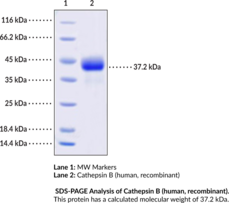
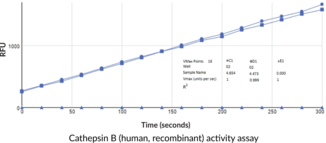
Technical Information
- Amyloid Precursor Protein Secretase
- APP Secretase
- APPS
- Cathepsin B1
- CPSB
- CTSB
- Cysteine Protease
Shipping & Storage Information
Recommended Products
Certificates of Analysis & Batch Specific Data
Provide batch numbers separated by commas to download or request available product inserts, QC sheets, certificates of analysis, data packs, and GC-MS data.

Visit Our Cancer Resource Center
Find Tools & Resources to Study the Hallmarks of Cancer
- Cancer cell signaling & regulation
- Cancer metabolism
- Tumor microenvironment
Product Description
Cathepsin B is a lysosomal cysteine protease and member of the papain family of peptidases that has endo- and exopeptidase activity.1,2 Cathepsin B is translated as an inactive preproprotein containing a signal peptide, precursor peptide, and catalytic domain.2 Following removal of the signal peptide, the precursor peptide is cleaved to release a single-chain polypeptide, which can be further cleaved and the pieces connected via disulfide bonds to form a double-chain form of the protein. Cathepsin B is ubiquitously expressed and localizes primarily to the lysosome where the acidic conditions are optimal for its dipeptidyl carboxypeptidase activity.1 It is involved in lysosomal protein degradation and maintenance of the intracellular proteome but is also found in the cytoplasm, mitochondria, or nucleus, at the plasma membrane, or secreted into the extracellular matrix and is involved in diverse functions, such as cell death, cell division, and degradation of structural proteins.3 In cancer cells, secreted cathepsin B cleaves and activates extracellular matrix proteins involved in invasion and metastasis.4,5 The expression or protein levels of cathepsin B are increased in a variety of cancers, including esophageal cancer, hepatocellular carcinoma, and prostate cancer. Cathepsin B has a complex role in Alzheimer’s disease, where it degrades amyloid-β but can also form pyroglutamic acid amyloid-β peptide, which has increased neurotoxicity compared with full-length amyloid-β (1-42).3,6 It is also involved in the binding of viruses to host cells via cleavage of the glycoproteins from Middle East respiratory syndrome coronavirus (MERS-CoV) and Ebola virus.7,8 Cayman’s Cathepsin B (human, recombinant) protein is provided as the latent zymogen form. After activation with dithiothreitol (DTT; Item No. 35885), it can be used for enzyme activity assays. The proprotein consists of 332 amino acids, has a calculated molecular weight of 37.2 kDa, and a predicted N-terminus of Phe74 after signal and precursor peptide cleavage. By SDS-PAGE, under reducing conditions, the apparent molecular mass of the protein is 36 or 43 kDa for the pro- and mature forms, respectively, due to glycosylation.
WARNING This product is not for human or veterinary use.
References & Product Citations
1. The refined 2.15 Å X-
2. Cathepsin B. Int. J. Biochem. Cell Biol. 29(5), 715-720 (1997).
3. The role of cathepsin B in pathophysiologies of non-
4. Cathepsin B: The dawn of tumor therapy. Eur. J. Med. Chem. 269, 116329 (2024).
5. Cell Surface Proteases. Current topics in developmental biology 54, 313-333 (2003).
6. Brain pyroglutamate amyloid-
7. MERS-
8. Filovirus entry into cells -
Contact Info
Cayman Chemical1180 East Ellsworth RoadAnn Arbor, Michigan 48108 USAToll Free: (800) 364-9897(USA and Canada only)Fax: (734) 971-3640


