
Technical Support & Resources
Visit our FAQ
Contact Us
Toll Free Phone (USA and Canada Only): (888) 526-5351
Direct Phone: (734) 975-3888
Product Categories
Product Type

Technical Information
- EFTR-2
- Embroyonic TEA Domain-containing Factor 2
- RTEF-1
- TEA Domain Transcription Factor 4
- TEF-3
- Transcriptional Enhancer Factor 3
Shipping & Storage Information
Recommended Products
Certificates of Analysis & Batch Specific Data
Provide batch numbers separated by commas to download or request available product inserts, QC sheets, certificates of analysis, data packs, and GC-MS data.

Visit Our Cancer Resource Center
Find Tools & Resources to Study the Hallmarks of Cancer
- Cancer cell signaling & regulation
- Cancer metabolism
- Tumor microenvironment
Product Description
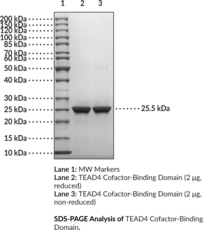
TEA domain transcription factor 4 (TEAD4) is a transcription factor and member of the TEA domain-containing family of transcription factors.1 It is composed of an N-terminal TEA DNA-binding domain, a hydrophobic proline-rich domain, and a C-terminal cofactor-binding domain (CBD), which binds TAZ or YES-associated transcriptional regulator (YAP), or vestigial-like proteins (VGLLs), and is involved in TAZ-, YAP-, or VGLL-dependent transcription of genes in the Hippo signaling pathway, which regulates embryonic and organ development, proliferation, and cell death.2 TEAD4 associates with VGLL3 to regulate growth and differentiation in primary mouse myotubes, but not primary mouse myoblasts, as well as with VGLL1, TAZ, or YAP to promote transcription of cell cycle and self-renewal genes and induce a trophectoderm lineage in human pluripotent stem cells (PSCs).3,4 The tertiary structure and function of TEAD4 requires C-terminal palmitoylation at residue 360.5 A CBD-only TEAD4 isoform binds TEAD cofactors and acts as a negative regulator of Hippo signaling, which decreases proliferation and the levels of epithelial-to-mesenchymal transition (EMT) proteins when expressed in cancer cells.6 Increased tumor levels of TEAD4 are associated with decreased survival time in patients with lung adenocarcinoma (LUAD), but increased levels of the CBD-only TEAD4 isoform in tumors are associated with increased survival time in patients with LUAD or colon cancer.7,6 Cayman's TEAD4 Cofactor-Binding Domain (human, recombinant) protein consists of 219 amino acids, has a calculated molecular weight of 25.5 kDa, and is depalmitoylated at cysteine 360.
WARNING This product is not for human or veterinary use.
References & Product Citations
1. An evolutionary, structural and functional overview of the mammalian TEAD1 and TEAD2 transcription factors. Gene 591(1), 292-303 (2016).
2. Targeting transcriptional enhanced associate domains (TEADs). J. Med. Chem. 61(12), 5057-5072 (2018).
3. VGLL3 operates via TEAD1, TEAD3 and TEAD4 to influence myogenesis in skeletal muscle. J. Cell Sci. 132(13), jcs225946 (2019).
4. VGLL1 cooperates with TEAD4 to control human trophectoderm lineage specification. Nat. Commun. 15(1), 583 (2024).
5. Palmitoylation of TEAD transcription factors is required for their stability and function in Hippo pathway signaling. Structure 24(1), 179-186 (2016).
6. A splicing isoform of TEAD4 attenuates the Hippo-
7. The transcription factor TEAD4 enhances lung adenocarcinoma progression through enhancing PKM2 mediated glycolysis. Cell Biol. Int. 45(10), 2063-2073 (2021).
Contact Info
Cayman Chemical1180 East Ellsworth RoadAnn Arbor, Michigan 48108 USAToll Free: (800) 364-9897(USA and Canada only)Fax: (734) 971-3640


