
Technical Support & Resources
Visit our FAQ
Contact Us
Toll Free Phone (USA and Canada Only): (888) 526-5351
Direct Phone: (734) 975-3888
Product Categories
Product Type
Application
Technical Information
- Acid Sphingomyelinase
- ASM
- aSMase
- Sphingomyelin Phosphodiesterase 1
- Zn-SMase
Shipping & Storage Information
Recommended Products
Certificates of Analysis & Batch Specific Data
Provide batch numbers separated by commas to download or request available product inserts, QC sheets, certificates of analysis, data packs, and GC-MS data.
Lipid Resource Center
Discover Products & Resources for Lipid Research
- High-purity lipid standards
- Lipid roles in biology
- Lipids in health & disease
- Lipids for pharmaceutical development
- Protocols, advice, & resources
Product Description
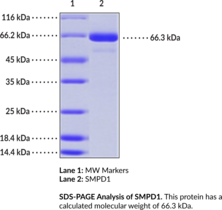
Acid sphingomyelinase, also known as sphingomyelin phosphodiesterase 1 (SMPD1), is a lysosomal and secretory phosphodiesterase.1 SMPD1, the gene encoding acid sphingomyelinase, produces three isoforms but only the full-length isoform is further processed into a precursor polypeptide, which is composed of an N-terminal signal peptide, a saposin-like (SAP) domain, a proline-rich domain, a metallophosphoesterase catalytic region, and a C-terminal domain. The precursor polypeptide is subject to post-translational modifications and alternative trafficking, which results in two enzymes: lysosomal sphingomyelinase (L-SMase), which is further cleaved to an N-terminus of Gly66, and secretory sphingomyelinase (S-SMase), which is further cleaved to an N-terminus of His60.1,2 Both enzymes catalyze the hydrolysis of sphingomyelin into ceramide and phosphocholine.1 Acid sphingomyelinase is ubiquitously expressed and hydrolyzes sphingomyelin in the endo-lysosome, in lipoproteins, and at the outer leaflet of the plasma membrane.3,1 It has roles in various cellular processes, including apoptosis, immune cell activation, and inflammation.2 Mutations in SMPD1 result in type A and B Niemann-Pick disease, a lysosomal storage disorder characterized by sphingomyelin accumulation in the endo-lysosome and visceral, neurological, and psychiatric symptoms.4,5 Cayman's SMPD1 (human, recombinant) protein can be used for enzyme activity assay applications. This protein consists of 593 amino acids, has a calculated molecular weight of 66.3 kDa, and a predicted N-terminus of Leu47 after signal peptide cleavage.
WARNING This product is not for human or veterinary use.
References & Product Citations
1. Roles and regulation of secretory and lysosomal acid sphingomyelinase. Cell Signal. 21(6), 836-846 (2009).
2. Physiological functions and therapeutic applications of neutral sphingomyelinase and acid sphingomyelinase. Biomed. Pharmacother. 139, 111610 (2021).
3. Ceramide/sphingosine/sphingosine 1-
4. The Niemann-
5. Acid sphingomyelinase deficiency: A clinical and immunological perspective. Int. J. Mol. Sci. 22(23), 12870 (2021).
Contact Info
Cayman Chemical1180 East Ellsworth RoadAnn Arbor, Michigan 48108 USAToll Free: (800) 364-9897(USA and Canada only)Fax: (734) 971-3640


