
Technical Support & Resources
Visit our FAQ
Contact Us
Toll Free Phone (USA and Canada Only): (888) 526-5351
Direct Phone: (734) 975-3888
Product Categories
Product Type
Research Area
Application
CD163L1 SRCR8 Domain (human, recombinant)
Item No. 41208
Technical Information
- CD163B
- CD163L1
- CD163 Antigen B
- CD163 Antigen-like 1
- CD163 Molecule-like 1
- hCD163L SRCR8
- M160
- Scavenger Receptor Cysteine-rich Type 1 Protein M160
Shipping & Storage Information
Recommended Products
Certificates of Analysis & Batch Specific Data
Provide batch numbers separated by commas to download or request available product inserts, QC sheets, certificates of analysis, data packs, and GC-MS data.
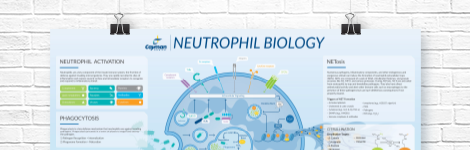
Neutrophil Biology Wall Poster
Explore how neutrophils shape the immune response in health and disease. This poster highlights neutrophil pathogen defense mechanisms, including phagocytosis, degranulation, and NETosis, as well as neutrophil roles in inflammation and NET-associated pathologies.
DOWNLOAD NOWProduct Description
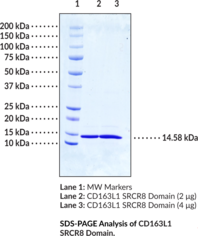
CD163 molecule-like 1 (CD163L1), also known as CD163 antigen B (CD163B), is an extracellular membrane receptor and a member of the scavenger receptor cysteine-rich (SRCR) family.1,2 It is composed of an N-terminal ectodomain, which contains 12 disulfide-rich SRCR class B domains that mediate protein-protein interactions, a transmembrane segment, and a short cytoplasmic tail.1 Alternative splicing of CD163L1 mRNA produces two variants that differ in length of the cytoplasmic tail.1,3 CD163L1 is found in monocytes and M2 macrophages and can be induced by colony-stimulating factor 1 (CSF1) and IL-10 in macrophages.3 Replacement of porcine CD163L1 SRCR5 domain with human CD163L1 SRCR8 domain increases resistance to porcine reproductive and respiratory syndrome virus 1 (PRRSV1) infection in pigs.4 Cayman's CD163L1 SRCR8 Domain (human, recombinant) protein consists of 105 amino acids and has a calculated molecular weight of 14.58 kDa.
WARNING This product is not for human or veterinary use.
References & Product Citations
1. Cloning of a novel scavenger receptor cysteine-
2. CD163 and inflammation: Biological, diagnostic, and therapeutic aspects. Antioxid. Redox Signal. 18(17), 2352-2363 (2013).
3. CD163L1 and CLEC5A discriminate subsets of human resident and inflammatory macrophages in vivo. J. Leukoc. Biol. 98(4), 453-466 (2015).
4. Replacement of porcine CD163 scavenger receptor cysteine-
Contact Info
Cayman Chemical1180 East Ellsworth RoadAnn Arbor, Michigan 48108 USAToll Free: (800) 364-9897(USA and Canada only)Fax: (734) 971-3640


