
Technical Support & Resources
Information provided in the product description is from published literature. Due to the nature of scientific experimentation, your results (e.g., selectivity and effective concentrations) or specific application for this product may differ. If you have questions about how this product fits your application, please contact our technical support staff.
Visit our FAQ
Contact Us
Toll Free Phone (USA and Canada Only): (888) 526-5351
Direct Phone: (734) 975-3888

Technical Information
- T-3912
Shipping & Storage Information
Recommended Products
Certificates of Analysis & Batch Specific Data
Provide batch numbers separated by commas to download or request available product inserts, QC sheets, certificates of analysis, data packs, and GC-MS data.
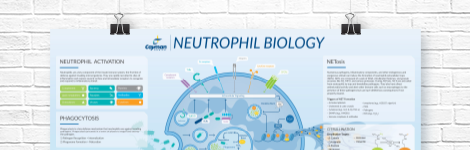
Neutrophil Biology Wall Poster
Explore how neutrophils shape the immune response in health and disease. This poster highlights neutrophil pathogen defense mechanisms, including phagocytosis, degranulation, and NETosis, as well as neutrophil roles in inflammation and NET-associated pathologies.
DOWNLOAD NOWProduct Description
Ozenoxacin is a quinolone antibiotic.1 It is active against clinical isolates of S. pyogenes, P aeruginosa, and P. acnes and clinical isolates of antibiotic-sensitive and -resistant S. aureus, S. epidermidis, and S. pneumoniae (MIC50s = 0.00625-1.56 mg/L). Ozenoxacin inhibits S. aureus DNA gyrase and topoisomerase IV (IC50s = 4.5 and 0.617 mg/L, respectively). It reduces insulin- or 5α-dihydroxy testosterone-induced triglyceride production and lipid droplet formation in primary hamster sebocytes when used at a concentration of 30 µM.2 Ozenoxacin (30 µg/ml) decreases heat-killed C. acnes-induced increases in IL-6 and IL-8 production in HEKa primary human keratinocytes and IL-1β, IL-6, IL-8, and TNF-α production in THP-1 monocytes.3 Topical application of ozenoxacin (1%) decreases skin lesion bacterial counts in a mouse model of burn infection caused by S. aureus.1 Formulations containing ozenoxacin have been used in the treatment of S. aureus- or S. pyogenes-associated impetigo.
WARNING This product is not for human or veterinary use.
References & Product Citations
1. In vitro and in vivo antibacterial activity of T-
2. Ozenoxacin suppresses sebum production by inhibiting mTORC1 activation in differentiated hamster sebocytes. J. Dermatol. 51(9), 1187-1198 (2024).
3. Anti-
Contact Info
Cayman Chemical1180 East Ellsworth RoadAnn Arbor, Michigan 48108 USAToll Free: (800) 364-9897(USA and Canada only)Fax: (734) 971-3640


