
Technical Support & Resources
Visit our FAQ
Contact Us
Toll Free Phone (USA and Canada Only): (888) 526-5351
Direct Phone: (734) 975-3888
Product Categories
Product Type
Technical Information
- Cellular Communication Network Factor 3
- IBP-9
- IGFBP-9
- IGFBP9
- IGF-binding Protein 9
- Insulin-like Growth Factor-binding Protein 9
- NOV
Shipping & Storage Information
Recommended Products
Certificates of Analysis & Batch Specific Data
Provide batch numbers separated by commas to download or request available product inserts, QC sheets, certificates of analysis, data packs, and GC-MS data.
Product Description
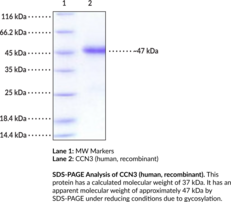
Cellular communication network factor 3 (CCN3) is a growth factor and member of the CCN protein family with roles in stem cell regulation, hematopoiesis, and the regulation of bone growth, as well as cell growth, differentiation, and migration.1,2 It is a secreted protein that is associated with the extracellular matrix (ECM) and is composed of a signal peptide linked to four structural domains: an insulin-like growth factor binding protein domain (IGFBP), a von Willebrand type C repeat (VWC), and a thrombospondin type I domain (TSP-1), all associated with protein binding, and a cysteine knot carboxyl terminal that promotes oligomerization. CCN3 is present in various stem cell lineages, including chondrogenic, osteogenic, and hematopoietic lineages, and acts through the core stem cell signaling pathways mediated by Notch and bone morphogenetic protein (BMP).1,3 Ccn3 expression is upregulated during early phase bone regeneration, and Ccn3-/- mice exhibit accelerated bone regeneration compared to wild-type mice, indicating Ccn3 is a negative regulator of this process.3 However, Ccn3 expression increases in KiSS1 neurons in the arcuate nucleus (ARCKiSS1) in female mice during lactation, and reduction of Ccn3 expression in ARCKiSS1 induces bone loss in female lactating mice fed a low-calcium diet.4 Cayman’s CCN3 (human, recombinant) protein can be used for binding assays. This protein consists of 337 amino acids, has a calculated molecular weight of 37 kDa, and a predicted N-terminus of Thr32 after signal peptide cleavage. By SDS-PAGE under reducing conditions, the apparent molecular mass of the protein is 47 kDa due to glycosylation.
WARNING This product is not for human or veterinary use.
References & Product Citations
1. CCN3 -
2. The emerging roles of CCN3 protein in immune-
3. CCN3 protein participates in bone regeneration as an inhibitory factor. The Journal of Biological Chemisty 288(27), 19973-19985 (2013).
4. A maternal brain hormone that builds bone. Nature (2024).
Contact Info
Cayman Chemical1180 East Ellsworth RoadAnn Arbor, Michigan 48108 USAToll Free: (800) 364-9897(USA and Canada only)Fax: (734) 971-3640


