
Technical Support & Resources
Visit our FAQ
Contact Us
Toll Free Phone (USA and Canada Only): (888) 526-5351
Direct Phone: (734) 975-3888
Technical Information
- Bcl-2A1
- Bcl-2-related Protein A1
- Hemopoietic-specific Early Response Protein
Shipping & Storage Information
Recommended Products
Certificates of Analysis & Batch Specific Data
Provide batch numbers separated by commas to download or request available product inserts, QC sheets, certificates of analysis, data packs, and GC-MS data.

Visit Our Cancer Resource Center
Find Tools & Resources to Study the Hallmarks of Cancer
- Cancer cell signaling & regulation
- Cancer metabolism
- Tumor microenvironment
Product Description
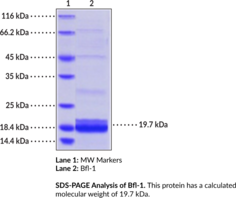
Bfl-1, also known as Bcl-2-related protein A1 (Bcl-2A1), is an anti-apoptotic member of the Bcl-2 family of proteins.1 It is composed of two Bcl-2 homology (BH) domains (BH1 and BH2), which facilitate binding to Bim, Bid, PUMA, and Noxa, putative BH3 and BH4 domains, and a C-terminal region that regulates localization and function.1,2 Bfl-1 expression can be induced by cytokines such as IL-1β and TNF-α and is primarily expressed in leukocytes, the spleen, and the lungs but is also expressed in the small intestine, testis, and thymus and localizes to the mitochondria.3,4 However, a short splice variant, Bfl-1S, localizes to the nucleus.5 Bfl-1 is involved in p53-dependent apoptosis and autophagy.2,6 Ectopic overexpression of BCL2A1 induces resistance to the Bcl-2 inhibitor venetoclax (ABT-199; Item No. 16233) in cancer cells, and Bfl-1 is overexpressed in several cancers.7,8 Cayman’s Bfl-1 (human, recombinant) protein consists of 170 amino acids and has a calculated molecular weight of 19.7 kDa.
WARNING This product is not for human or veterinary use.
References & Product Citations
1. Attacking cancer’s Achilles heel: Antagonism of anti-
2. BH3 mimetics in hematologic malignancies. Int. J. Mol. Sci. 22(18), 10157 (2021).
3. Cloning of human Bcl-
4. C-
5. Bfl-
6. Last but not least: BFL-
7. Discovery of a covalent inhibitor that overcame resistance to venetoclax in AML cells overexpressing BFL-
8. BCL2A1: The underdog in the BCL2 family. Cell Death Differ. 19(1), 67-74 (2012).
Contact Info
Cayman Chemical1180 East Ellsworth RoadAnn Arbor, Michigan 48108 USAToll Free: (800) 364-9897(USA and Canada only)Fax: (734) 971-3640


