
Technical Support & Resources
Visit our FAQ
Contact Us
Toll Free Phone (USA and Canada Only): (888) 526-5351
Direct Phone: (734) 975-3888
Technical Information
- Folate Hydrolase 1
- FOLH1
- GCPII
- Glutamate Carboxypeptidase II
- NAALADase
- Prostate-specific Membrane Antigen
Shipping & Storage Information
Recommended Products
Certificates of Analysis & Batch Specific Data
Provide batch numbers separated by commas to download or request available product inserts, QC sheets, certificates of analysis, data packs, and GC-MS data.

Visit Our Cancer Resource Center
Find Tools & Resources to Study the Hallmarks of Cancer
- Cancer cell signaling & regulation
- Cancer metabolism
- Tumor microenvironment
Product Description
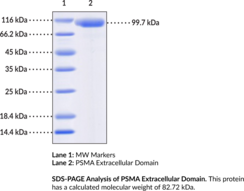
Prostate-specific membrane antigen (PSMA) is a type II membrane glycoprotein and glutamate-preferring carboxypeptidase with roles in folic acid utilization and metabolism that is encoded by FOLH1 in humans.1,2 It is composed of a short intracellular sequence, a transmembrane domain, and a large extracellular region, which contains enzymatic domains.1,3 PSMA is expressed in prostate epithelial cells and in the proximal small intestine, where it promotes folate uptake by cleaving glutamate from folypoly-γ-glutamate, and in the central nervous system, where it regulates neurotransmitter activity by cleaving glutamate from N-acetyl-aspartyl-glutamate (NAAG).2,4 It is also highly overexpressed in prostate carcinomas and in the neovasculature of various renal, colon, and breast carcinomas to support the need for folate in these rapidly dividing cells.2,4 Expression of FOLH1 increases under androgen deprivation conditions in vitro and in vivo and positively correlates with cancer aggressiveness in patients with prostate cancer.1 PSMA PET imaging is commonly used in the diagnosis and staging of prostate cancer, as well as to assess therapeutic response.3 Cayman's PSMA Extracellular Domain (human, recombinant) - Biotinylated protein consists of 732 amino acids and has a calculated molecular weight of 82.72 kDa. By SDS-PAGE, under reducing conditions, the apparent molecular mass of the protein is 99.7 kDa due to glycosylation.
WARNING This product is not for human or veterinary use.
References & Product Citations
1. Overview of prostate-
2. Heterogeneity of prostate-
3. Nonprostatic diseases on PSMA PET imaging: A spectrum of benign and malignant findings. Cancer Imaging 20(1), 23 (2020).
4. Tumor target prostate specific membrane antigen (PSMA) and its regulation in prostate cancer. J. Cell. Biochem. 91(3), 528-239 (2004).
Contact Info
Cayman Chemical1180 East Ellsworth RoadAnn Arbor, Michigan 48108 USAToll Free: (800) 364-9897(USA and Canada only)Fax: (734) 971-3640


