
Technical Support & Resources
Visit our FAQ
Contact Us
Toll Free Phone (USA and Canada Only): (888) 526-5351
Direct Phone: (734) 975-3888
Technical Information
- Protein Tyrosine Phosphatase 1D
- Protein Tyrosine Phosphatase 2C
- PTP-1D
- PTP-2C
- PTPN11
- SH-PTP2
- SH-PTP3
- Src Homology Region 2 Domain-containing Phosphatase-2
- Tyrosine-protein Phosphatase Non-Receptor Type 11
Shipping & Storage Information
Recommended Products
Certificates of Analysis & Batch Specific Data
Provide batch numbers separated by commas to download or request available product inserts, QC sheets, certificates of analysis, data packs, and GC-MS data.

Visit Our Cancer Resource Center
Find Tools & Resources to Study the Hallmarks of Cancer
- Cancer cell signaling & regulation
- Cancer metabolism
- Tumor microenvironment
Product Description
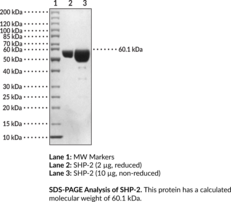
Src homology region 2 domain-containing phosphatase 2 (SHP-2) is a non-receptor protein tyrosine phosphatase (PTP) and a member of the PTP family.1 It is composed of an N-terminal Src homology region 2 (SH2) domain, a second SH2 domain, a PTP domain, a disordered C-terminal tail, which can serve as a binding site for adaptor proteins when phosphorylated, and a proline-rich sequence.2 Under basal conditions, the N-terminal SH2 domain binds to and inhibits the PTP domain, but disassociates in the presence of phosphorylated tyrosine residues on activated receptor tyrosine kinases or adaptor proteins to which it can also bind.2,3 SHP-2 is ubiquitously expressed and is involved in both positive and negative regulation of growth factor-, cytokine-, interferon-, or insulin-induced signaling pathways by dephosphorylating receptors, signaling intermediates, or kinases.1 SHP-2 binds phosphorylated programmed cell death protein 1 (PD-1) and decreases the levels of CD69 on the surface of, and IL-2 secretion from, T cell receptor-activated Jurkat T cells.4 Conditional knockout of Ptpn11, the gene expressing SHP-2, in myeloid cells, but not in mature T cells, reduces tumor volume, increases the tumor draining lymph node levels of effector and central memory T cells, and decreases the splenic levels of myeloid-derived suppressor cells (MDSCs), in a B16/F10 melanoma mouse xenograft model.5 Germline and somatic mutations in PTPN11 have been found in patients with both juvenile myelomonocytic leukemia (JMML) and Noonan syndrome, an autosomal developmental disorder characterized by facial abnormalities, decreased height, cardiac defects, such as pulmonary valve stenosis or hypertrophic cardiomyopathy, and skeletal malformation, and in a smaller percentage of patients with myelodysplastic syndrome (MDS) or acute myeloid leukemia (AML).3 Cayman's SHP-2 (human, recombinant) protein consists of 525 amino acids and has a calculated molecular weight of 60.1 kDa.
WARNING This product is not for human or veterinary use.
References & Product Citations
1. The SHP-
2. Revealing mechanisms for SH2 domain mediated regulation of the protein tyrosine phosphatase SHP-
3. Somatic mutations in PTPN11 in juvenile myelomonocytic leukemia, myelodysplastic syndromes and acute myeloid leukemia. Nat. Genet. 34(2), 148-150 (2003).
4. Molecular mechanism of SHP2 activation by PD-
5. SHP-
Contact Info
Cayman Chemical1180 East Ellsworth RoadAnn Arbor, Michigan 48108 USAToll Free: (800) 364-9897(USA and Canada only)Fax: (734) 971-3640


