
Technical Support & Resources
Visit our FAQ
Contact Us
Toll Free Phone (USA and Canada Only): (888) 526-5351
Direct Phone: (734) 975-3888
Product Categories
Product Type
Technical Information
- TGF-β1 Latency-associated Peptide
- Transforming Growth Factor β1 LAP
- Transforming Growth Factor β1 Latency-associated Peptide
Shipping & Storage Information
Recommended Products
Certificates of Analysis & Batch Specific Data
Provide batch numbers separated by commas to download or request available product inserts, QC sheets, certificates of analysis, data packs, and GC-MS data.
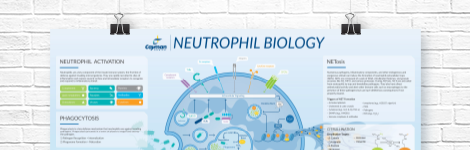
Neutrophil Biology Wall Poster
Explore how neutrophils shape the immune response in health and disease. This poster highlights neutrophil pathogen defense mechanisms, including phagocytosis, degranulation, and NETosis, as well as neutrophil roles in inflammation and NET-associated pathologies.
DOWNLOAD NOWProduct Description
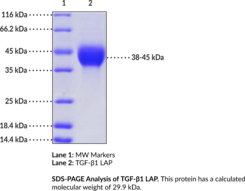
Transforming growth factor β1 (TGF-β1) is a multifunctional cytokine and member of the TGF-β superfamily.1,2 It is an extracellular dimeric protein that is produced by multiple cell types, including macrophages, platelets, neutrophils, regulatory T cells, and renal tubular cells, and is the most abundantly expressed isoform of TGF-β. TGF-β1 is expressed as a proprotein that is cleaved in the Golgi to form TGF-β1 latency-associated peptide (LAP) and mature TGF-β1.2 TGF-β1 LAP and TGF-β1 remain non-covalently bound until mature TGF-β1 is released from latency by various proteins, including matrix metalloproteinases and plasmin, to regulate immune function, epithelial-mesenchymal transition, and cell proliferation. TGF-β1 LAP inhibits TGF-β1-induced inflammation and fibrosis in HSC-T6 rat hepatic cells and H9c2 rat cardiomyocytes, as well as in a mouse model of carbon tetrachloride-induced liver fibrosis.3,4 Cayman’s TGF-β1 LAP (human, recombinant) protein consists of 260 amino acids, has a calculated molecular weight of 29.9 kDa, and a predicted N-terminus of Leu30 after signal peptide cleavage. By SDS-PAGE, under reducing conditions, the apparent molecular mass of the protein is ~38-45 kDa due to glycosylation.
WARNING This product is not for human or veterinary use.
References & Product Citations
1. TGF-
2. TGF-
3. Recombinant truncated latency-
4. Prokaryotic expression, purification and evaluation of anti-
Contact Info
Cayman Chemical1180 East Ellsworth RoadAnn Arbor, Michigan 48108 USAToll Free: (800) 364-9897(USA and Canada only)Fax: (734) 971-3640


