
Technical Support & Resources
Visit our FAQ
Contact Us
Toll Free Phone (USA and Canada Only): (888) 526-5351
Direct Phone: (734) 975-3888
Product Categories
Research Area
Technical Information
- Phospholipase D-like Domain-containing Protein
- PLD
Shipping & Storage Information
Recommended Products
Certificates of Analysis & Batch Specific Data
Provide batch numbers separated by commas to download or request available product inserts, QC sheets, certificates of analysis, data packs, and GC-MS data.
Lipid Resource Center
Discover Products & Resources for Lipid Research
- High-purity lipid standards
- Lipid roles in biology
- Lipids in health & disease
- Lipids for pharmaceutical development
- Protocols, advice, & resources
Product Description
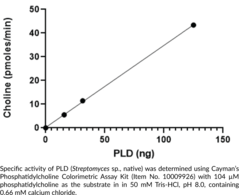
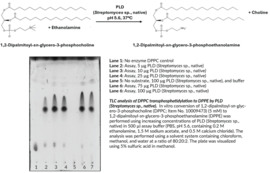
Phospholipase D (PLD) enzymes are hydrolases found in mammals, plants, and bacteria.1 PLD enzymes contain at least one copy of a His-x-Lys-xxxx-Asp sequence called the HKD motif, which is central to their catalytic activity. Streptomyces PLDs typically contain two HKD motifs and two additional conserved regions. PLD hydrolyzes phosphatidylcholine to generate choline and phosphatidic acid or, in the presence of an alcohol acceptor, catalyzes transphosphatidylation to produce choline and a phosphatidyl alcohol, such as phosphatidylethanol. PLD-mediated transphosphatidylation activity is higher than hydrolytic activity for several Actinomycetes PLDs, including those from Streptomyces, but the ratio of these activities varies among enzymes.2,3 PLD transphosphatidylation has been used at research and industrial scales to produce natural and unnatural phospholipids.1,4 Cayman’s Phospholipase D (Streptomyces sp., native) can be used for the transphosphatidylation of phospholipids and for enzyme assay, SDS-PAGE, and Western blot applications.
WARNING This product is not for human or veterinary use.
References & Product Citations
1. Phospholipase D mechanism using Streptomyces PLD. Biochim. Biophys. Acta 1791(9), 962-969 (2009).
2. Isolation and characterization of actinomycetes strains that produce phospholipase D having high transphosphatidylation activity. Microbiol. Res. 164(1), 43-48 (2009).
3. Phospholipase D: Enzymology, functionality, and chemical modulation. Chem. Rev. 111(10), 6064-6119 (2011).
4. Phospholipase D as a catalyst: Application in phospholipid synthesis, molecular structure and protein engineering. J. Biosci. Bioeng. 116(3), 271-280 (2013).
Contact Info
Cayman Chemical1180 East Ellsworth RoadAnn Arbor, Michigan 48108 USAToll Free: (800) 364-9897(USA and Canada only)Fax: (734) 971-3640


