
Technical Support & Resources
Visit our FAQ
Contact Us
Toll Free Phone (USA and Canada Only): (888) 526-5351
Direct Phone: (734) 975-3888
Product Categories
Product Type
Technical Information
- Histone Deacetylase 10
Shipping & Storage Information
Recommended Products
Certificates of Analysis & Batch Specific Data
Provide batch numbers separated by commas to download or request available product inserts, QC sheets, certificates of analysis, data packs, and GC-MS data.

Visit Our Cancer Resource Center
Find Tools & Resources to Study the Hallmarks of Cancer
- Cancer cell signaling & regulation
- Cancer metabolism
- Tumor microenvironment
Product Description
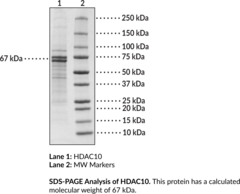
Histone deacetylase 10 (HDAC10) is a zinc-dependent metalloenzyme and class IIb HDAC.1 It is composed of an N-terminal catalytic domain and a C-terminal leucine-rich domain. HDAC10 is ubiquitously expressed and shuttles between the cytoplasm and nucleus.2 It acts as a transcriptional corepressor and deacetylates histones and polyamines, such as N8-acetylspermidine.2,3 HDAC10 is involved in DNA damage repair, autophagy, and inflammation.4 Overexpression of HDAC10 promotes proliferation of lung cancer cells in vitro, and knockout of Hdac10 protects mice against allergic airway inflammation.5,6 SNPs in HDAC10 have been found in patients with schizophrenia.7 Cayman’s HDAC10 (human, recombinant) protein has a calculated molecular weight of 67 kDa.
WARNING This product is not for human or veterinary use.
References & Product Citations
1. Class II histone deacetylases: From sequence to function, regulation, and clinical implication. Mol. Cell. Biol. 25(8), 2873-2884 (2005).
2. Isolation and characterization of mammalian HDAC10, a novel histone deacetylase. The Journal of Biological Chemisty 277(1), 187-193 (2002).
3. Histone deacetylase 10 structure and molecular function as a polyamine deacetylase. Nat. Commun. 8:15368, (2017).
4. Histone deacetylase 10, a potential epigenetic target for therapy. Biosci. Rep. 41(6), BSR20210462 (2021).
5. HDAC10 promotes lung cancer proliferation via AKT phosphorylation. Oncotarget 7(37), 59388-59401 (2016).
6. The HDAC10 instructs macrophage M2 program via deacetylation of STAT3 and promotes allergic airway inflammation. Theranostics 13(11), 3568-3581 (2023).
7. Family-
Contact Info
Cayman Chemical1180 East Ellsworth RoadAnn Arbor, Michigan 48108 USAToll Free: (800) 364-9897(USA and Canada only)Fax: (734) 971-3640


