
Technical Support & Resources
Visit our FAQ
Contact Us
Toll Free Phone (USA and Canada Only): (888) 526-5351
Direct Phone: (734) 975-3888
Product Categories
Product Type
Technical Information
- Growth Differentiation Factor 8
- Myostatin
Shipping & Storage Information
Recommended Products
Certificates of Analysis & Batch Specific Data
Provide batch numbers separated by commas to download or request available product inserts, QC sheets, certificates of analysis, data packs, and GC-MS data.
Product Description
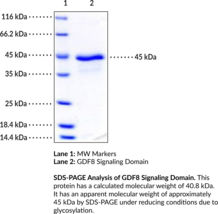
Growth differentiation factor 8 (GDF8) is a myokine and member of the TGF-β superfamily.1,2 It is produced in skeletal and cardiac muscle cells as a proprotein, which shares sequence identity between the human, mouse, and rat.1,3 The proprotein is cleaved in the endoplasmic reticulum into a protein containing a prodomain and C-terminal signaling domain.1,4,3 This protein is secreted and forms homodimers that either circulate or remain near the extracellular membrane in a latent state.5 The prodomain is cleaved by bone morphogenetic protein 1 (BMP1) or tolloid family metalloproteinases, releasing the signaling domain to activate TGF-β receptor type 2 (TGFBR2) and negatively regulate muscle growth and differentiation.5,1,2 Knockout of Myst, the gene expressing Gdf8, increases muscle mass, muscle fiber length, bone mineral content (BMC), and bone size in Myst-/- mice compared to wild-type mice.6 The levels of full-length GDF8 and GDF8 prodomain are increased in left ventricle tissue samples from patients with dilated- or ischemic cardiomyopathy.3 Cayman's GDF8 Signaling Domain (human, recombinant) protein is a disulfide-linked homodimer. The reduced monomer, composed of GDF8 (amino acids 267-375) fused to human IgG1 Fc at its N-terminus, consists of 369 amino acids and has a calculated molecular weight of 40.8 kDa. This protein consists of 108 amino acids and has a predicted N-terminus of Gly20 after signal peptide cleavage. As a result of glycosylation, the monomer migrates to approximately 45 kDa by SDS-PAGE under reducing conditions.
WARNING This product is not for human or veterinary use.
References & Product Citations
1. Myostatin: Basic biology to clinical application. Adv. Clin. Chem. 106, 181-234 (2022).
2. Regulation of skeletal muscle mass in mice by a new TGF-
3. Myostatin activation in patients with advanced heart failure and after mechanical unloading. Eur. J. Heart Fail. 12(5), 444-453 (2010).
4. Myostatin, a transforming growth factor-
5. Activation of latent myostatin by the BMP-
6. Myostatin (GDF-
Contact Info
Cayman Chemical1180 East Ellsworth RoadAnn Arbor, Michigan 48108 USAToll Free: (800) 364-9897(USA and Canada only)Fax: (734) 971-3640


