
Technical Support & Resources
Visit our FAQ
Contact Us
Toll Free Phone (USA and Canada Only): (888) 526-5351
Direct Phone: (734) 975-3888
Technical Information
- CAB-63
- CaBP3
- Calcium-binding Reticuloplasmin
- CALR
- CALR1
- Calregulin
- Calsequestrin-like Protein
- cC1qR
- CRP55
- CRT
- CRTC
- Endoplasmic Reticulum Resident Protein 60
- ERp60
- FLJ26680
- grp60
- HACBP
- High-affinity Calcium-binding Protein
- HEL-S-99n
- RO
- SSA
Shipping & Storage Information
Recommended Products
Certificates of Analysis & Batch Specific Data
Provide batch numbers separated by commas to download or request available product inserts, QC sheets, certificates of analysis, data packs, and GC-MS data.

Visit Our Cancer Resource Center
Find Tools & Resources to Study the Hallmarks of Cancer
- Cancer cell signaling & regulation
- Cancer metabolism
- Tumor microenvironment
Product Description
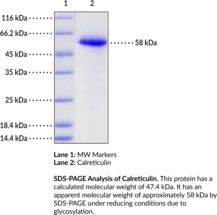
Calreticulin is a calcium-binding protein involved in intracellular calcium storage and glycoprotein folding, among other processes.1,2 It is composed of an N-terminal globular N domain, a proline-rich P domain containing a high-affinity, low-capacity calcium-binding site, an acidic C domain containing a low-affinity, high-capacity calcium-binding site, and a C-terminal endoplasmic reticulum retention sequence.3 Calreticulin is widely expressed and localizes primarily to the lumen of the endoplasmic or sarcoplasmic reticulum in non-muscle or muscle cells, respectively, but is also found at the cell surface, in the extracellular matrix, and in the cytoplasm.3,4,1 It has a high calcium-binding capacity and is involved in the regulation of intracellular calcium homeostasis, which makes it an integral factor in many calcium-related processes, such as muscle contraction and the cellular stress response.3,4 Calreticulin also acts as a chaperone for newly synthesized glycoproteins in conjunction with protein disulfide-isomerase A3, also known as ERp57, and calnexin in the calreticulin/calnexin cycle to ensure proper glycoprotein folding.1 Insertion or deletion mutations in exon 9 of CALR, the gene encoding calreticulin, are found in a subset of patients with essential thrombocythemia or primary myelofibrosis and are associated with increased overall survival and a lower risk of thrombosis.5 Cayman's Calreticulin (human, recombinant; His-tagged) protein consists of 407 amino acids, has a calculated molecular weight of 47.4 kDa, and a predicted N-terminus of Glu18 after signal peptide cleavage. By SDS-PAGE, under reducing conditions, the apparent molecular mass of the protein is 58 kDa due to glycosylation.
WARNING This product is not for human or veterinary use.
References & Product Citations
1. Glycoprotein quality control and endoplasmic reticulum stress. Molecules 20(8), 13689-13704 (2015).
2. Calreticulin: Non-
3. Calreticulin. Biochem J. 285(Pt 3), 681-692 (1992).
4. Calreticulin signaling in health and disease. Int. J. Biochem. Cell Biol. 44(6), 842-846 (2012).
5. Somatic mutations of calreticulin in myeloproliferative neoplasms. N. Engl. J. Med. 369(25), 2379-2390 (2013).
Contact Info
Cayman Chemical1180 East Ellsworth RoadAnn Arbor, Michigan 48108 USAToll Free: (800) 364-9897(USA and Canada only)Fax: (734) 971-3640


